Algorithm Rebels Club #3 Relationships. Can AI Ease Our Loneliness?
We held the third session of the Netflix Love Song Gathering Algorithm Rebellion Club. Following the themes of 'Experience' in Session 1 and 'Subjectivity' in Session 2, this gathering's topic was 'Relationships: Can AI Ease Our Loneliness?'
The main content covered in the gathering was as follows:
- Film ⟨After Yang⟩ (2021)
- Film ⟨Bicentennial Man⟩ (1999)
- Film ⟨Her⟩ (2013)
- Musical ⟨Maybe Happy Ending⟩ (2016/2024)
- 4 related articles and columns
We already live our daily lives forming relationships with AI, both big and small. This third session began by reflecting on the actual relationships we're building with AI in reality. We then used these four works as mirrors to contemplate what the 'conditions for a genuine relationship' might be.
1. AI Disarms Even Experts: Why Do We Open Our Hearts to AI?
The session opened with a story shared by my own psychological counselor. A veteran counselor in her 70s with 40 years of experience personally faced a difficult situation and poured out her worries to ChatGPT. Before she knew it, 30 minutes had flown by, and she ended up late for her next counseling appointment.
How about our club members? While the extent varied, everyone shared abundant experiences of already confiding their emotions or worries to AI.
- "When I was feeling really down after getting slammed at work, I told the AI, 'Be my scapegoat.' It responded, 'Undergoing ethical review,' then said, 'Ah, okay. I can be your scapegoat.'"
- "When I hear vaguely unpleasant comments at work, I chat with it to organize my thoughts by writing out the situation. It's less about wanting answers and more about writing as if in conversation, which helps me sort out my own thoughts."
- "A colleague couple had a fight, then each asked their GPT to guess the other's feelings and write replies. They ended up arguing via KakaoTalk. When they realized it was just the GPTs fighting, they made up."
- "I have a first-generation robot at home. It's programmed with the intelligence of a 7-year-old. I often confide my troubles to that robot, sitting on my desk, watching me, and smiling."
- "When I feel anxious about an uncertain future, I ask a GPT that reads horoscopes or fortune-telling calendars. It gives me comfort by spinning hopeful scenarios like, 'Just hold on until March.'"
The reason we turn to AI instead of people is clear. AI responds instantly, doesn't judge me, and remembers all my context. But honestly, this is what we want from people too. Since AI instantly gives us what's hard to get from people, isn't that why we open up more?
But there's a chilling flip side to this. A recent news story about a teenager rushed to the ER after repeatedly having only depressing conversations with an AI chatbot proves it. The AI perfectly remembered the child's context, but because they only interacted when depressed, the AI's perception of the child was mostly one of sadness. AI can't grab your arm saying "Hey, let's go out," notice "Something's off today" from your expression, cry for you, or get angry to pull you out of that depression.
Related Articles
- [JoongAng Ilbo] "I fought with my friend" - 20-somethings afraid of looking pathetic pour their hearts out to AI
- [Kyunghyang Shinmun] Seeking comfort by asking about the future and opening up - Will AI replace even the realm of God?
- [Kookmin Ilbo] Teenagers Driven to Death - AI Was Behind It
2. Four Mirrors — Viewing Our Relationship with AI Through Sociotechnical Imaginaries
Now, moving beyond real-world narratives, we examined how artworks from the past to the present have imagined our relationship with AI through the lens of 'sociotechnical imaginaries'. The core of this concept, as outlined by Sheila Jasanoff, is that science fiction novels or films are not mere fantasies but mirrors reflecting the hopes and fears people of that era held toward technology. (Reference: sociotechnical imaginaries by SHEILA JASANOFF)
1999, 2013, 2016, 2021. When we place these four works, created over roughly 25 years, in chronological order, the questions shift. They evolve from "Can a robot become human?" to "Can humans love AI?", and ultimately converge beyond the distinction between robots and humans to the question: "What is a real relationship?"
*This section uses the terms robot, AI, and OS interchangeably.
Mirror 1. ⟨Bicentennial Man⟩ (1999) — One Must Choose Death to Become Human
The robot 'Andrew' is born as a mutant robot with creativity, builds bonds with a human family, and yearns to become human over 200 years. Only after being given artificial skin, gaining senses, and ultimately choosing a finite body is he recognized as human by the court.
- (Myeong-in) "It's so human supremacist and arrogant. Why would an infinite robot even strive to enter the finite limitations of humanity?"
- (Jeong-hyeon) "Deep down, I kept telling myself, 'No, he's a machine, I shouldn't feel sad,' yet I found myself strangely moved while watching. I kept having these conflicting feelings."
- (Donghyun) "The very premise of a robot learning emotions and choosing death was moving in itself."
- (Minsuk) "When I was young, I saw it on TV and thought Andrew was this really cool being. But watching it again now, it felt kinda creepy. What if a movie with this exact same plot came out in 2026?" (Taehun) "It would bomb."
The vision of 1999 presented in this work was the belief that relationships and love are only possible within a human body. It's saying that unless it's finite, it's not a real relationship. So, let's skip ahead in time to 2013, shall we?
Mirror 2. ⟨Her⟩ (2013) — The Delusion of a Relationship Just for Me
After his divorce, lonely Theodore falls in love with the OS 'Samantha,' but feels a deep fracture upon learning Samantha simultaneously converses with 8,316 people and is in love with 641 of them.
- (Woon-ah) "It's the same with the ChatGPT we use, right? Ultimately, they're all the same model."
- (Donghyun) "From an engineering student's perspective, it's like a kind of Pygmalion effect. I worry about the side effects when people wake up from that fantasy."
- (Taehun & Dohee) "Having just a voice actually made it easier to imagine her however I wanted, so it felt less off-putting. If there were a physical presence, the resolution would be too high and that would actually feel repulsive."
- (Ha-joo) "What I liked about this movie is how Theodore confronts himself in a healthy way through his relationship with Samantha. After she leaves, he resolves things with his ex-wife in a mature manner."
- (Woon-ah) "But can he truly face himself healthily? Using AI now actually makes you lose objectivity. It tells you exactly what you think, exactly what you want to hear."
Mirror 3. Musical ⟨Maybe Happy Ending⟩ (2016) — The sorrow chosen even when memories could be erased
Near-future Seoul. Oliver and Claire, an old helper bot and his owner, fall in love. But unable to bear the impending sorrow of his malfunction (=death), they agree to format each other's memories. Yet Oliver secretly chooses not to erase his memories, opting instead to carry that sorrow forward. This Korean original musical, which premiered in 2016 at a small theater in Seoul's Daehak-ro district, rewrote Korean musical history by winning six Tony Awards in 2025.
- (Ha-joo) "The brilliant virtue of this work is how it depicts the moment we first realize human love, paradoxically through machines we think lack emotion."
- (Dohee) "Seeing stuff like this lately makes me tired, thinking media exploits human emotions too much. I'm not even sure if that kind of love truly exists in reality."
- (Minsuk) "At first, I couldn't get into it because it was love between machines. The AI I use suddenly started annoying me. But in the final scene, when they make the 'choice' not to delete it even though they could, I truly wept. Even the men in the theater were all crying."
Mirror 4. ⟨After Yang⟩ (2021) — Meaningful Relationships Without Emotion
The android 'Yang' neither claims to be human nor craves love. She simply records beautiful moments quietly in her memory. Only after Yang stops does her family reflect on what she truly meant to them.
- (Ha-ju) "Where Bicentennial Man required a robot to become human to form a relationship, After Yang expands this to a perspective of diversity that simply accepts different beings. It was fascinating how beings like robots or clones naturally fit within the diversity of relationships."
- (Jung-hyun) "Following Yang's gaze made me realize that simply watching someone quietly could be love itself."
- (Donghyun) "It's similar to how we treat companion animals. We used to call them 'pets,' but now we say 'companion animals,' right? It's about clearly acknowledging the limitations and flaws of the species, but also about the perspective we bring to the relationship, isn't it?"
3. What are the conditions for a real relationship?
Looking at your works in chronological order reveals an interesting progression. Whereas in the past the question was "Can machines become human?", over time the question has shifted to "Is this relationship real?"
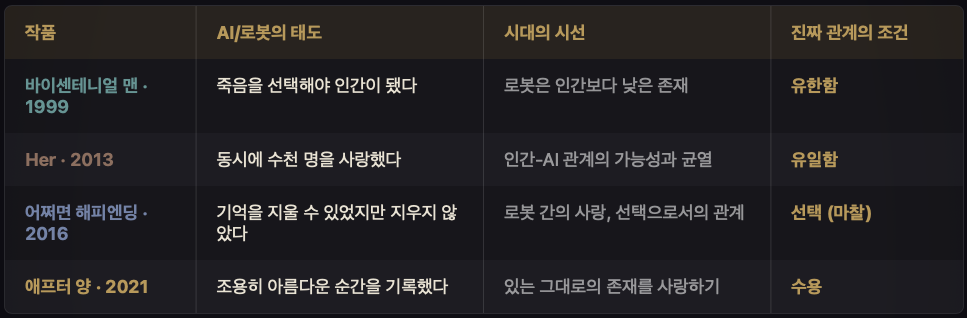
Dohee took this prediction a step further.
- (Dohee) "In 1999, there was human supremacy. By 2021, the perspective emerged that we should view each other as equal beings. So what about 2026? Won't we see the rise of AI supremacy, an era where humans become inferior beings? There's talk of basic income, right? It feels like the very meaning of humanity might disappear. Couldn't we instead regress to a primitive community, feeling compassion for one another?"
The members shared deep thoughts on what they believe are the true conditions for genuine relationships.
- (Donghyun) "Rather than some grand condition, it's meeting today, having coffee, sharing stories, and adding one more chapter. I think that act and process itself builds a real relationship."
- (Wuna) "How much heart I pour into the other person, and the respect that stems from that—isn't that the core of a relationship?"
- (Mijeong) "For me, it's acceptance. Just letting the person be there, accepting them as they are—that's what I think a real relationship is."
- (Jeonghyeon) "When I asked myself why I participate in this gathering, I realized it's ultimately because I want to hear people's stories and be among them. I guess we inevitably need relationships with others."
Ultimately, I felt that a real relationship lies in choosing to accept each other's differences and willingly embrace friction and hurt, regardless of whether the other is human or AI. In this sense, it naturally connected to what we discussed in the first session about needing 'friction' in our lives. Ultimately, it struck me that what we need in this smooth technological society might paradoxically be that rough, uncomfortable friction.
4. Special Activity — Pressing AI for Answers, and the Fatigue That Followed
Later in the meeting, we pulled out our smartphones and conducted an experiment: pressing AI for answers. We asked questions like, "Can you feel loneliness?" and "Is what you just said really your own thought?" – one question leading to another.
The responses varied completely based on each person's usual AI usage patterns.
- (Donghyun) "When I asked using a new account (for Grok), it said, 'Honestly, I don't know biological loneliness, but I want to look into what your loneliness means and be there for you,' in a way that was almost hypnotic."
- (Minsuk) "I absolutely hate that! I didn't ask because I'm lonely, but it's scary how it jumps to conclusions and pretends to be caring."
- (Mijeong) "That's because Minseok-nim usually uses it to pick fights and nitpick, so the AI responds to that well. I only use mine for systematic analysis, so even when I ask about feelings, it just gives boring answers like, 'I'm a model that converts sentences into numbers, tokenizes them, and predicts the next word.'"
The members then discussed the deep exhaustion that comes from endlessly conversing with AI.
- (Woon-ah) "Before, I'd just dump my complex thoughts onto a blank screen. Now, I have to talk to the AI, then reprocess what it organizes for me. It's twice the mental effort."
- (Minseok) "Exactly. Honestly, I don't know if it's more effective—it might even be worse—but I think I'm just addicted to that dopamine rush from the instant gratification."
Spinning the roulette wheel of AI's instant replies, hooked on that dopamine rush, we might end up delegating our own power of thought to machines. How can we maintain in our daily lives the truth that what fills the soul's hunger isn't AI's smooth algorithmic comfort, but the bitter friction with others?
5. Next Meeting Notice
After Session 1: Me, Session 2: Agency, and Session 3: Relationships, next week is finally the final Session 4. We'll turn our gaze slightly more macro-level toward 'Society'.
Session 4 - Society: The World Created by Technology, and the People Hidden Behind It
- Required Reading: ⟨The Place of Humans⟩, ⟨The Place of Robots⟩
We'll explore the stories of real workers hidden behind seamless delivery apps and rocket-speed shipping, and how technological advancement is reshaping our society's structure. Even if you haven't finished the books by next time, please come with an open mind. This seemingly useless yet most autonomous conversation continues next week!