The Ones Who Keep Questioning - Reflections on FALL 2026 Ethics+Tech Public Policy Practitioner Course
This post was originally written in Korean and translated into English with AI assistance.
From September to November 2026, I completed Ethics, Technology, and Public Policy for Practitioners (ETPP), offered by Stanford University’s McCoy Family Center for Ethics in Society. This online, cohort-based course brought together more than a hundred practitioners working across technology, ethics, and public policy around the world. Even the application required short essays: how we understood our identities as practitioners, why we wanted to join and what we hoped to accomplish, and what we thought made learning in a cohort special.
Looking back, I think the course began when I started writing those essays. I took time to consider what motivated me in my work, where I felt I was falling short, and what I hoped to learn from others. A few weeks after submitting them, I received an acceptance email from the ETPP team. It included a note that they had read every essay themselves, without using AI. I really was joining a course on technology ethics! That small detail made me even more excited.

I hadn’t read long texts, attended lectures, or joined discussions in English since university, so that was what made me most nervous. To keep up, I organized the readings and essay prompts in Obsidian before each session and built a small study tool that runs on my own computer to follow the course. Two months went by like that. What stayed with me most?
The greatest gift was the questions. More precisely, I rediscovered the power of coming up with questions and sharing them with other people. Throughout the course, we read articles, papers, and books, and responded to carefully designed essay prompts. I would somehow finish an essay and rush to submit it the day before class, only to feel, once the session began, how thin my thinking had been. The fireside chats brought vivid accounts from people working in different fields, while my fellow participants’ sharp questions gave me more to learn. After about an hour and a half, we met the familiar faces in our smaller cohorts. Guided by our cohort leader, we asked one another questions and shared what was happening in our countries. Stories from Mexico, India, Korea, and the United States; experiences in Silicon Valley, government, and civic tech. Listening to these wonderful people from such different workplaces, I felt ideas I had held firmly being taken apart and rebuilt.
Over the seven sessions, we read and discussed a range of topics, including fairness in algorithmic decision-making, data collection and privacy, the regulation of AI and platform companies, online child sexual abuse material, and AI’s impact on work. Here, I want to write about a few of the sessions that stayed with me most.
In the fourth session, we explored how to govern AI with Florence G’Sell, a visiting professor of private law at Stanford’s Cyber Policy Center. The first chapter of her report, Regulating Under Uncertainty, and “Anticipatory AI Ethics” by Seth Lazar, a Johns Hopkins professor working on AI ethics and political philosophy, made me consider how to prepare for technological effects we do not yet fully understand. How can we act without pretending to know the future, but also without waiting for harm to occur?
As I listened to their conversation, I kept returning to responsibility for AI agents. We have held people responsible for misusing tools. But when a tool interprets instructions and carries out several steps on its own, how should responsibility be shared? I thought of the increasingly popular AI services that make calls and reservations on our behalf. Something convenient for me might impose an unwanted burden on the person answering the phone. If something goes wrong, how much responsibility belongs to the user, the developer, or the organization operating the service? Asking these questions first might slow technological development. Perhaps it would. But I could not simply call speed a good thing if it came from postponing the burdens someone else would bear. When I explained a technology’s usefulness, I needed to consider its effects on people who did not use it, too.
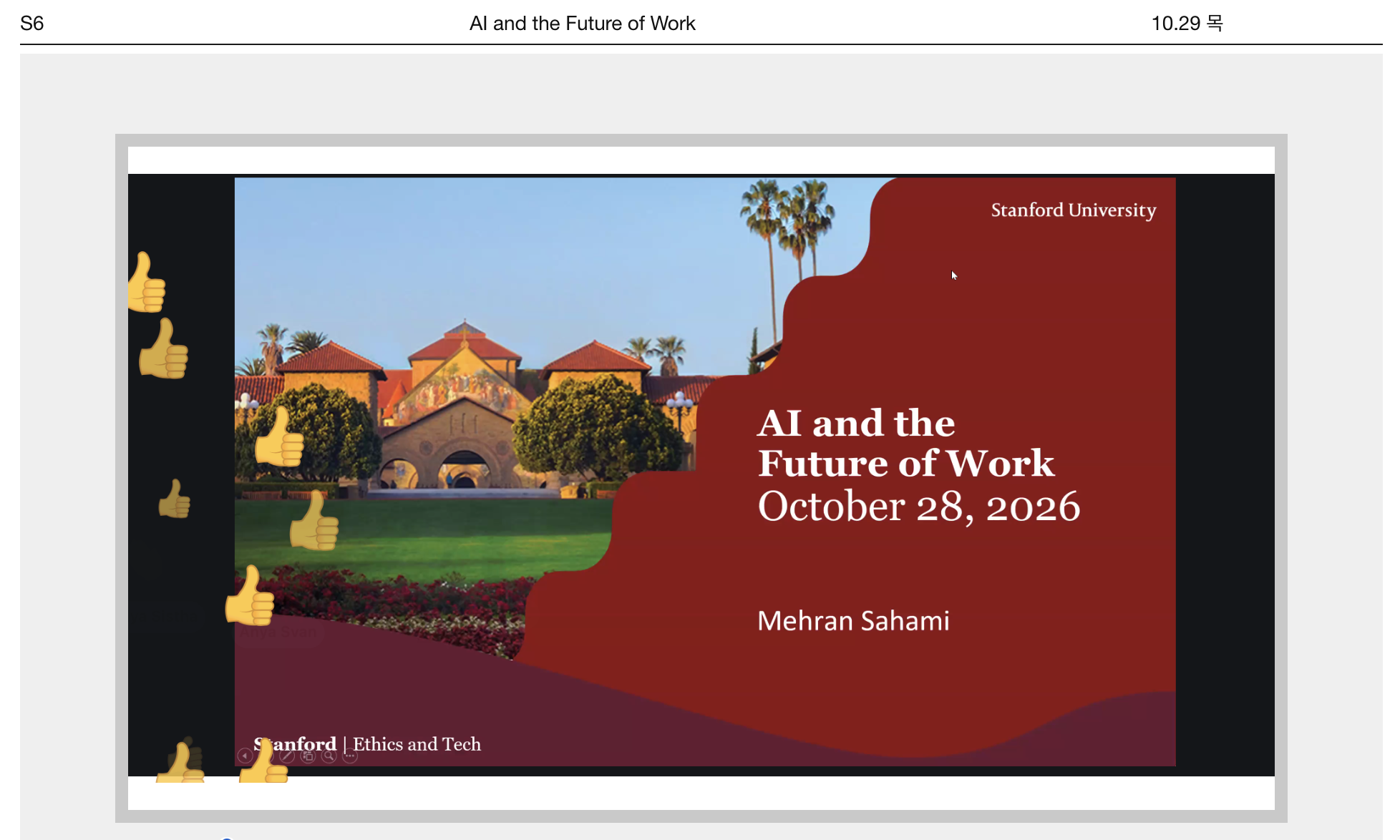
In the sixth session, Stanford computer science professor Mehran Sahami explored AI and the future of work. “Choosing AI’s Impact on the Future of Work”, by MIT economics professor Daron Acemoglu and MIT Sloan entrepreneurship professor Simon Johnson, described two directions: AI that replaces people and AI that complements their capabilities. Their argument that technology’s direction is not predetermined, and that workers need a voice in choosing it, aligned closely with my own thinking. We also read “Canaries in the Coal Mine? Six Facts about the Recent Employment Effects of Artificial Intelligence”, by the research team led by Erik Brynjolfsson, director of the Stanford Digital Economy Lab. Its analysis of young workers’ employment in occupations highly exposed to AI made me think again about whose opportunities were changing beneath the broad productivity figures, especially for people just entering working life.
These questions led back to time at work. When AI helps us finish a task faster, who gets the time we save? Can workers rest, spend it on something they find more meaningful, or will they simply be given more work? Different topics kept bringing me back to similar questions. Who decides how these changes happen? Whose convenience and whose burdens are being considered? Do the people affected have a say? Technical performance alone could not answer them.
Throughout the course, I asked questions, received questions, and found myself full of new ones. And that was philosophy. It reminded me why I loved the subject: the freedom to ask, to question familiar judgments, and to try to make sense of a world without settled answers.
That pleasure was strongest in the first and last sessions, led by Rob Reich, a political scientist and philosopher who holds Stanford’s McGregor-Girand Professorship in Social Ethics of Science and Technology. He also leads the McCoy Center’s Ethics, Society, and Technology Initiatives and serves as associate director of the Institute for Human-Centered AI. As we discussed Ursula K. Le Guin’s “The Ones Who Walk Away from Omelas” and N. K. Jemisin’s “The Ones Who Stay and Fight”, he kept asking questions. An answer would prompt a question about its reasoning, an invitation to consider another perspective, or a push to imagine what we would actually do in that situation. Even while choosing between two options, we could question why those were the only choices. I would find myself nodding, then pausing, then reconsidering an idea that had seemed convincing only moments before. “Moral caffeination” was exactly the right phrase. I was asking things I had never thought to ask, my mind continually waking up, with no chance to settle into familiar assumptions. It was exhilarating.
In the final session, those questions reached into the limits of the worlds I could imagine. At work, I usually begin with what is possible under current conditions. But had I been imposing those limits before even imagining a better world? Having constraints to consider when taking action did not mean I had to narrow my hopes in advance. From questioning my own judgments to imagining possibilities that did not yet exist: it felt good to give myself that freedom again.
Looking back, the design of the course itself also resembled something I wanted to do. ETPP grew out of an undergraduate course at Stanford created by Reich, computer scientist Mehran Sahami, and political scientist Jeremy Weinstein. It brought together ethics and the humanities, social science and policy, and technical perspectives to examine technology’s effects on society. ETPP extended that learning to practitioners already making decisions about technology in business, civil society, and government.
What I want to create is something similar. A place where people bring questions from their workplaces, read together, put their thoughts into writing, and reconsider them through questions from people in other fields. A place where understanding technology and asking what kind of lives we want are part of the same learning, and where that learning can gradually shape people’s next decisions. I would like to help build such a space. I think I will remember how we learned together just as much as what I learned.
As it happened, I had just finished the book of critical essays on AI, which I had been writing all year, when the course began. During these weeks, I began to feel that I needed to revise its ending. I wanted to write words that would carry my questions to other people, rather than leave them inside me. Even if it seemed futile, even if it could not produce a major change right away, helping more people keep the conversation going would mean something. I wanted to play a part in that.
I still do not know how much change continuing to talk can bring. Conversations can feel powerless when the people in the room cannot immediately change a decision. Yet throughout this course, I repeatedly experienced my own thinking changing because of someone else’s question. I hope I can offer that kind of question to others, too. With colleagues at work and people I read and study with, I want to keep talking about what matters to us as we live with technology.
I leave ETPP with a new map of questions and ideas, full of paths I have yet to explore. As Davey said in our final session, ETPP is only beginning. Now I want to think about how to explore these questions more deeply, connect them with what others have already studied, bring them into my work, and discuss them with other people. I am grateful to ETPP for introducing me to people I can keep asking questions with, and to so much more to read and learn.
+ And thank you to Kakao Impact for letting me start work late every Thursday morning!