Algorithm Rebels Club #1 Reclaiming My Real Experience from Technology
1. Group Leader Introduction and Self-Introduction
Group Leader Self-Introduction
- Double major in Computer Science + Philosophy
- 6 years at NCsoft planning developer services → Currently doing technical planning at Kakao Impact
- Practicing algorithm resistance since 2022
Personal Practices
- Stopped watching YouTube → Turned off algorithmic recommendations
- Deleted SNS from mobile, access only via PC
- Operates personal blog byminseok.com
- Set guidelines for Claude: "Support healthy independent thinking," "Socratic questioning method"
Career Transition
- Latest tech at game companies → Tech supporting non-profits/social enterprises
- Example: AI medication counseling service for village pharmacists increased consultations by 6x
Member Introductions
- Tae-yoon: "I work in architectural design. While AI offers convenience, I realized there's much you gain only through human thought and experience. But if you just rely on AI's power without that, I don't think the experience truly comes to you. That's why I'm here."
- Taehoon: "I work in the IT team at a clothing company. Lately, I've caught myself just using GPT or Gemini without thinking… I want to think more for myself and expand my thinking."
- Haeju: "I work at Kakao Impact, like Minseok. I originally worked in social issues and welfare, then moved to a foundation that incorporates technology. Honestly, my major was pure liberal arts, so I still get flustered when encountering tech… I hope to get more comfortable with it over these four sessions."
- Taehong: "I'm a developer. I use AI a lot, but I came because I want to understand the necessity behind using it when I don't."
- Mijeong: "I work in business planning at an edtech company. AI education is super hot right now, and it's being thrown around mindlessly everywhere. I started wondering if that's really the right approach… Also, YouTube Music just can't figure out my taste at all. I got curious about why the algorithm behaves this way, so I joined."
- Hyesung: "I'm a product designer. Even while working in this field, I felt I was being exposed to these things too easily… Sometimes it felt like such an intangible job. So I became more interested in experiences where you can physically feel something."
- Dohui: "I'm a media artist. I used to work very technically, but recently I've been focusing less on technology and more on narrative or storytelling in my work."
- Myeongin: "I'm a graphic designer. I worked at a company before returning to university. At school, they push us to use AI a lot… but I often feel it's different from the context of learning Photoshop or Illustrator to become a designer back then – it feels like approaching it purely as a technical skill."
2. What is the Philosophy of Technology?
Presentation
- Major Fields of Philosophy: Metaphysics, Epistemology, Ethics, Logic
- Philosophical Subjects: Philosophy of Art, Political Philosophy, Aesthetics, Philosophy of Technology, Philosophy of Religion, etc. > "Philosophy of technology means viewing the relationship between technology and humanity with fresh eyes in a world where technology has become taken for granted." (Son Hwa-cheol, ⟨Preparing to Meet the Future⟩)
Myth → Philosophy → Back to Myth?
- The Age of Myth: Seeking answers from gods like Zeus and Poseidon
- The Age of Philosophy: Thales asks "What is the world made of?" → Questioning what is taken for granted
- 21st Century Myth: Algorithms and AI become new gods
- "YouTube videos recommended by AI"
- "Technology accepted as naturally as Poseidon"
Why We Need Philosophy of Technology
- Technology is not divine; it is created by humans (developers, designers)
- We must view technology with fresh eyes and ask questions
Meeting Structure
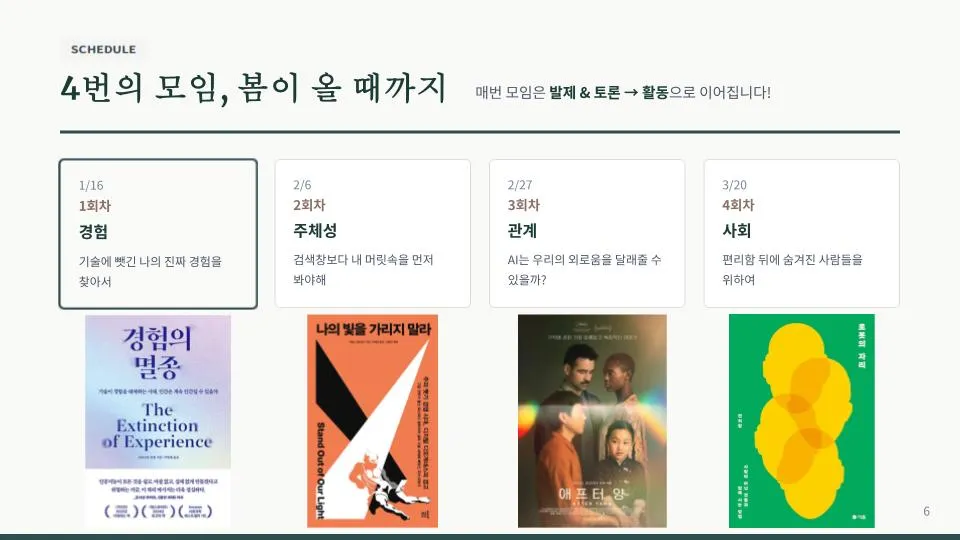
- Composed of 4 sessions, each exploring themes: 'Experience', 'Subjectivity', 'Relationship', 'Society'
- Today marks the beginning: Discussion centered on Christine Rosen's The Extinction of Experience
 ## 3. First Topic: Waiting and Boredom (Chapter 4)
Presentation How many seconds can we wait?
- 3 years ago: 4 seconds
- Now: 2 seconds (people leave if it exceeds 3 seconds)
- Google engineers compete over milliseconds; even a 400-millisecond delay feels long
- Minseok's experience: Closed and reopened a squash booking app because it didn't load within 3 seconds
Our Inability to Tolerate Gaps
- Checking phones while waiting in restrooms, elevators, or at traffic lights
- Why traffic lights now have signals on the ground: Because everyone looks at their phones
The Value of Boredom
- Managing boredom requires self-control
- To know who you are and what you like, you need time, patience, boredom, and the anticipation of discovery
- "The reason everyone rushes elsewhere, toward the future, is that no one has yet arrived at themselves" (book quote)
The Paradox of Information
- "Information consumes the recipient's attention"
- Too much information → Attention poverty
Discussion Questions
- In the last 24 hours, when did you get annoyed because you couldn't wait even 2 seconds?
- What abilities or senses of yours have disappeared along with boredom?
Conversation
- In the last 24 hours, when did you get annoyed because you couldn't wait even 2 seconds?
- Hyesung: "I think 2 seconds is my limit too. I try to watch YouTube, but the internet's bad and it won't play. Then instead of waiting, I keep turning it off and on again…"
- Minsuk: "A junior colleague at work watches dramas at double speed. I asked, 'Doesn't the OST sound weird at double speed?' They said, 'That's why I watch dramas with great historical OSTs at normal speed, but almost everything else at double speed.' When I asked why, they said, 'Because time is precious. There's just too much to watch in this world.'"
- Mijeong: "I watch the ending first. I press the playback bar all the way to the end to see what happens, then rewind and watch from the beginning. I can't stand the suspense. Seeing the ending first makes the foreshadowing clearer and more fun."
- What abilities or senses have I lost along with boredom?
- Dohee: "I used to love daydreaming and doodling when bored… But since I use my phone so much, I just keep looking at it even when there's nothing to see. Daydreaming and doodling seem to have disappeared."
- Hyesung: "I live with my family, but we talk way less than before. With phones… there's so much high-quality content these days. The algorithm just keeps showing me stuff I like, so sometimes watching that is more fun."
- Taehun: "On the subway, Wi-Fi connects automatically, right? But sometimes it cuts out. Then you have to turn it off immediately. Hearing that made me realize, 'Ah, I guess I'm someone who can't even wait two seconds.' I thought about losing money rather than the abilities or senses I've lost along with boredom… Like YouTube ads – you could just wait, but people pay to avoid waiting. And switching to LTE… I realized we're losing money because we can't stand waiting, can't stand boredom."
- Hae-joo: "You just said we're losing money. That makes me think time is the most expensive thing in our society now. Isn't this situation where we can't stand wasting time happening more and more to everyone because of technology… Even five minutes in the bathroom feels too precious, so we take our phones with us. We've gained impatience instead of just boredom. FOMO (Fear Of Missing Out) probably stems from that too. The fear that there might be better information or content out there that I don't know about."
- Tae-hong: "I think it's bad that we learn things that were once blissful ignorance. For example, if you search about swimming and see 'You can get hurt doing this,' you won't do it. Seeing injury videos just scares you more. If that info hadn't existed, you probably would've just done it…"
- Myeong-in: "When the internet is slow and won't load, I think, 'There must be a problem.' I can't tolerate slowness, so I go hunting for the cause. That connects to… my tolerance for situations or people who seem less capable really drops. I can't stand situations that don't get done quickly. And that often comes back as overwork. Because I demand that much from others, others demand the same from me…"
4. Second Theme: Disappearing Places, Personalized Spaces (Chapter 7)
Presentation The Paradox of Place
- "The technology that liberates us from place tracks us everywhere" (GPS)
Travel vs. Tourism (from Chapter 6)
- Tourism: Regrets time, no anxiety (packages, guides)
- Travel: Enjoys time, anxious about the unknown
- "We don't explore; we pose in place" (certification shot culture)
Convenience and Isolation
- Can contact Danish friends, yet didn't speak to next-door neighbor for 3 months
- Get in and out of taxis without exchanging a word
- Deliveries mean no need to encounter people
- Disappearance of chance encounters, neighborly warmth, physical community, sense of rootedness
Minseok's Experience
- Didn't know front-door neighbor for 3 months → Mutual friend created KakaoTalk group → Only then did conversation begin
- Squash court as a third place: A space to loosely connect and meet people
Discussion Questions
- Beyond home/work/school, do you have an offline third place—a space where you can exist as yourself and loosely mingle with strangers?
- "Safe online isolation" vs. "Uncomfortable physical community" – which do you lean toward? Which would you prefer?
Conversation
- Do you have an offline third place outside home/work/school where you can exist as yourself and casually mingle with strangers?
- Ha-joo: "My third place is the theater. I can fully focus on the story unfolding before my eyes, reflect on it by relating it to myself, and look inward. For me, that space is the theater."
- Mi-jeong: "There's a cafe I've been going to since I was young. The owner is friends with my friends. When I go, he tells me 'who came and went' – the visitor log. But then I feel like I have to keep the conversation going, like I have to tell interesting stories… So I actually ended up not going there often." (laughs)
- "Safe online isolation" vs "Uncomfortable physical community" – which is it? Which do you want to move towards?
- Ha-joo: "I feel like I'm gradually leaning toward safe isolation too. I surround myself mostly with people I know well and who are on the same wavelength. But I know that's not healthy, so I try to create some cracks by traveling or coming to communities like this."
- Tae-yoon: "I pursue physical community, but my current state is online isolation. I moved up from the provinces with few connections, and everyone around me is in construction, making life feel dull. That's partly why I came here."
- Mi-jeong: "I lean toward completely safe online isolation, but I think I come to gatherings like this to break out of it."
5. Third Theme: Friction and Resistance (Epilogue)
> We must reintroduce friction into our smooth lives
The Paradox of Technology
- Technology is both a tool of liberation and a tool of oppression
- It liberated places → but tracks us via GPS
- It made going anywhere possible → but led to safe online isolation
What is Friction?
- Not merely inconvenience
- An essential resistance that slows life's pace and allows us to set our own direction
- Like friction in physics: Without friction, we cannot walk (we slip like walking on ice)
- Without resistance, we cannot live properly
Friction Maxing
- A concept introduced in a column for The Cut magazine (early 2026)
- Image: People comfortably seated on a sofa vs. people laboriously rolling a stone
- Especially emphasized in parenting: Children need experiences with friction rather than just staring at iPads
Minseok's Translation
- Friction Maxing = "Deliberately choosing discomfort"
- Not for discomfort, but to reclaim resistance
- Avoid flowing along the smooth path created by algorithms; stand on your own two feet and choose your own direction
Minseok's Practical Examples
- Waking up naturally without an alarm (awakened naturally at 6 AM)
- Automatically turns on Classic FM radio at 6:55 AM to fully listen to the 7 AM program opening
- Turns off YouTube algorithm (stops viewing history)
- Deletes SNS from mobile, accesses only via PC
- Turns off all app notifications (including KakaoTalk)
- Automatically switches phone to personal mode upon arriving home (calls don't ring either)
Discussion Questions
- What resistance or friction do you encounter with the techniques you already practice?
- The infinite expansion and freedom of technology vs. acknowledging human limits and creating friction
- What can you gain by choosing discomfort/friction?
- What is true freedom?
Discussion
- What resistance or friction do you experience with technologies you already use?
- Kyem Song (Netflix Manager): "When listening to music, I avoid streaming and instead play LPs or cassette tapes. It's a hassle, but I think the process of physically selecting, organizing, and reinserting them brings me closer to the music."
- Dohee: "When I travel, I deliberately go to places without internet. When hiking, there's no signal, and it's dangerous to use your phone. It forces a detox, and I feel like it's somehow healing."
- Hyesung: "Starting this year, I wake up, turn off my alarm, and begin meditation. I try not to look at my phone. I want to start my mornings reflecting on myself, not wasting time on other things. And when I used to search for cafes to visit on weekends, I'd get so exhausted I felt like I'd already been there. Now, I just pick an area and walk around, thinking 'This place looks nice, I'll go in,' and I just go in."
- Ha-joo: "I walk distances of about 2-3 subway stops. Especially after late nights at work, I intentionally get off early and walk. Choosing something inefficient and doing it physically feels like resetting, like hitting zero, and I like that."
- Tae-yoon: "When navigating, I could go this way or that way, but I always take a different alley. Even commuting—one day that way, another day this way."
- Tae-hoon: "I didn't realize what I do is resistance against technology, but showing up here feels like part of that resistance too. There's really no need to meet in person to talk, honestly."
- Myeong-in: "I write by hand. Everyone at school types on iPads, but I can't type while listening, so I take notes. Once I asked a friend, 'Do you have any paper?' and they said, 'That's such a weird question,' and 'No, I don't.'" (Laughter) "But when I write things down by hand, I get a more intuitive sense of where my own shortcomings lie."
- Tae-hong: "I think aiming for high-tech is actually a form of resistance to technology. For example, the Apple Pencil creates a more pen-like writing experience, right? It's about rejecting that digital feel by developing digital technology further to give an analog-like sensation… That's what I aim for."
- The infinite expansion and freedom of technology vs. acknowledging human limitations and creating friction
- Gyeomsong: "The truth is, we were born human… I think the reason we've been able to thrive this much is because of solidarity. Knowing we're flawed, yet also knowing technology can't fix everything—sharing those flaws with each other is what it means to live humanly. The next generation might not choose to be human."
- Dohee: "A smooth world is boring. What if we all had unlimited money, infinite time, and perfect routines? When I left my job, enduring time alone was unbearably hard. But that led to many unexpected experiences and a much more interesting life unfolding. Rather than a smooth, predictable environment created by technology, there are so many new spaces I can pioneer. Shouldn't we adopt an attitude that we shouldn't be so quick to dismiss that?"
- Hyesung: "I think discomfort helps me understand myself better. If everything is just smooth, it might feel satisfying and make you want to stop there. But people tend to focus more on uncomfortable sensations, which helps them understand themselves better. When I ask myself, 'Why does this feel uncomfortable?', I realize, 'Ah, I'm someone who finds this uncomfortable, someone who needs this much space.' I think I've come to understand that about myself better than through purely positive experiences."
- Ha-joo: "Savoring it. It could be about the meaning of time, or just the meaning of that scenery."
- Taehoon: "Isn't it about experience? There's a line from The Matrix I love: 'Knowing the way and walking the way are different.' Actually experiencing something and just knowing about it are definitely different. There are so many things we know but can't bring ourselves to do, right?"
- Minsuk: "That idea that the next generation might not choose to be human… It could happen. There's a line in a Geomjeongchima song, right? 'What if our generation is the last?' It's sad. We might be the last human species… But it's also kind of funny that we're having this conversation today."
6. Activity: Drawing My Timeline
Presentation
Activity Description
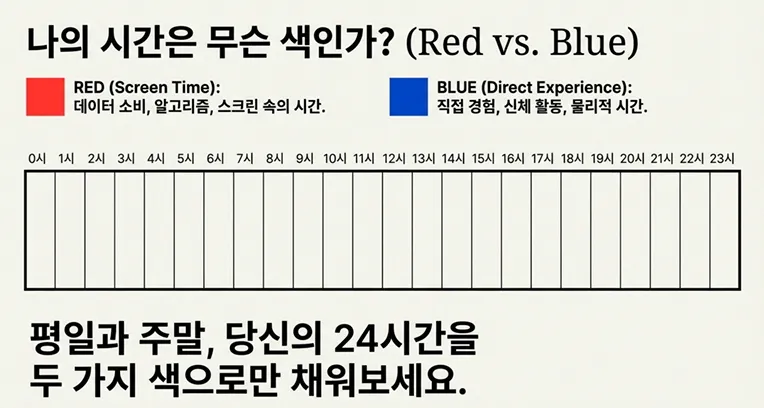
- Distribute one sheet of paper and one set of colored pencils
- Red: Time spent on screens, consuming data
- Blue: Time spent experiencing things directly with my body
- Draw one weekday and one weekend day
- Work individually for 5 minutes, then share
Conversation
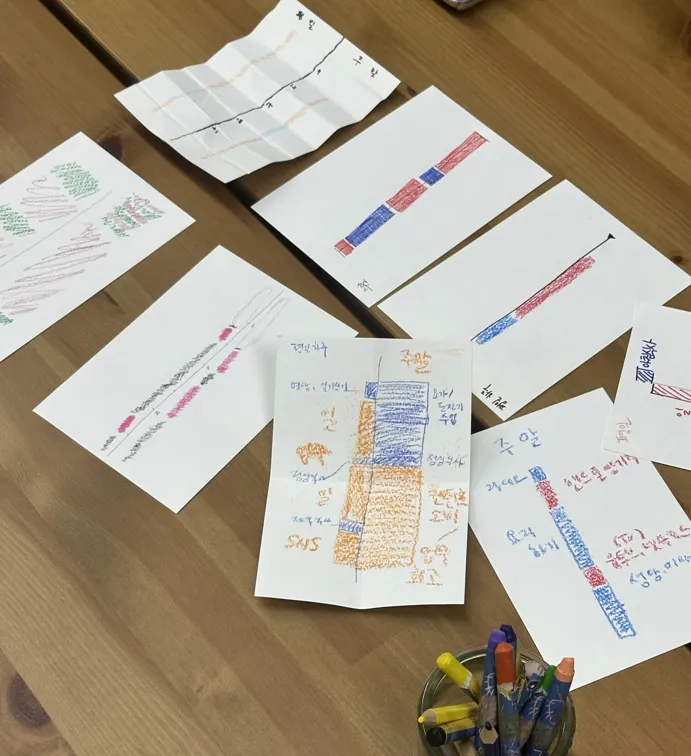
- Taehoon: "I realized I'm almost always doing it. From the moment I wake up… I turn off the alarm and play a podcast or something, listen while washing up and getting ready, listen all the way to work. I don't turn it off for a single moment, start work, and sometimes even listen while working. On weekdays, only from 6 PM to 9 PM is blue. That's when I exercise or take a class. After that, until bedtime… I fall asleep watching something. Weekends are similar. I even have something playing while I'm deep cleaning. The only time it turns blue is when I go to the movie theater to watch a film—I can't use my phone then."
- Hyesung: "On weekdays, I wake up, meditate, write in my journal, get ready, and then work straight through. At lunch at the office, there are people around and we chat, so I actually don't look at my phone much. But after work… I try to read books, but I end up scrolling through social media until I fall asleep. On weekends, I do yoga or take pottery classes. I go from morning until lunchtime, and when I get home, that's when I start consuming content. I mostly catch up on variety shows or something like that."
- Minsuk: "I have a Zoom meeting called 'Creative Mornings' in the morning. I write, read, or prepare for the meeting then. I head to work a bit later. Sometimes I work late, so it's kind of a reward for that… (laughs) I wake up at 5:40 at home and leave around 10. I spend those 4 hours mostly without my phone, writing, reading, or cooking. After work, I go play piano or play squash at the squash court. During baseball season, I watch games, so I'd probably be red all the way. But tomorrow, my Nintendo Switch 2 is getting delivered. So somehow, I feel like tomorrow might be all red…" (bursts out laughing)
- Tae-yoon: "On weekdays, it's almost always red. I think he does it all except when he's eating." Other participants: "You don't look at it while eating? That's amazing!" Tae-yoon: "Yeah, I focus on my food. Weekends are different. I used to stay home, but lately, I just wake up and think 'let's go out,' so I just go. Even without plans. I feel like spending the whole day looking at my phone is such a waste. I just want to get out no matter what and feel like I've been somewhere."
 —
—
7. Closing the Meeting
Conversation
- Tae-hong: "I was really worried because I'm so shy, but I'm glad I'm getting a little more comfortable. I'm satisfied with that." (Laughter)
- Ha-joo: "It was a bit different from the 'getting comfortable with technology' I expected, but hearing about friction maximization made me think, 'This itself could be that.' Seeing Myeong-in take out a diary made me write by hand for the first time in ages, and it was so nice to rediscover that forgotten sensation."
- Myeongin: "I thought we'd be tackling problems really seriously, maybe getting a bit heavy, but we ended up talking about things closer to everyday life. I thought I wasn't taking the lead… Drawing in red made me realize I just keep looking at it from the moment I lie down in bed. It gave me another chance to find those uncomfortable spots."
- Taehoon: "The meeting went pretty much as I expected. It felt well-prepared, and I gained insights… I think I can cancel YouTube Premium now, so I'll save about 20,000 won a month." (laughs)
- Dohui: "It was great that many people could share empathy about the problem I've been struggling with. I'm actually planning a project around this topic. It gave me a bit more confidence in the subject."
- Hyesung: "Even though it was the same question, everyone's experiences and thoughts were different, so it felt like my own thinking expanded. And I thought I was living without distractions in the morning, but when I actually drew it out, everything except pottery and yoga was red… I think I'll have to reflect on that."
- Tae-yoon: "People at work don't really like this kind of talk. Lately, it's all about 'transfer dating'… that sort of thing." (laughs) "It was good to share things today that I couldn't talk about at work or with people around me. And it was even better to see how many people had such diverse opinions."
- Minsuk: "I've been really interested in this topic for a long time. I majored in computer science and philosophy, and I work in a related field too… But at work, we talk to achieve business goals, not just to share thoughts. Today's conversation wasn't about achieving anything; it was just about sharing our thoughts. I think we need more of these seemingly useless moments. Not that this time was useless, but we need more opportunities to have these kinds of conversations and meet with others, even if they don't directly boost productivity. Thank you so much for staying focused until late tonight, and for all your hard work despite my various questions and requests."
8. Next Meeting Notice
Session 2: Agency - Look Inside Your Own Mind Before the Search Bar
- Date: February 6, 2026
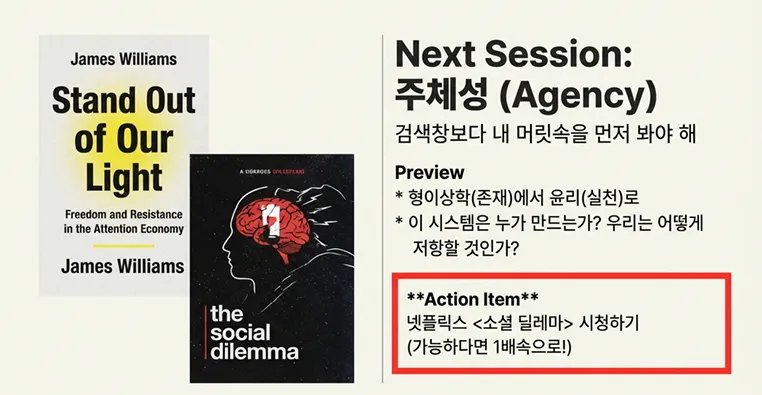
- Book to Read: James Williams, Don't Dim My Light
- Documentary to Watch: Netflix ⟨The Social Dilemma⟩
Minseok: "If today's discussion was metaphysical, next week's will be about ethics. Who creates this world that turns us all red? Why are they doing it? And how should we live?"