[25/03/22] STS Workshop - Key Questions and Reflections
Translated from Korean
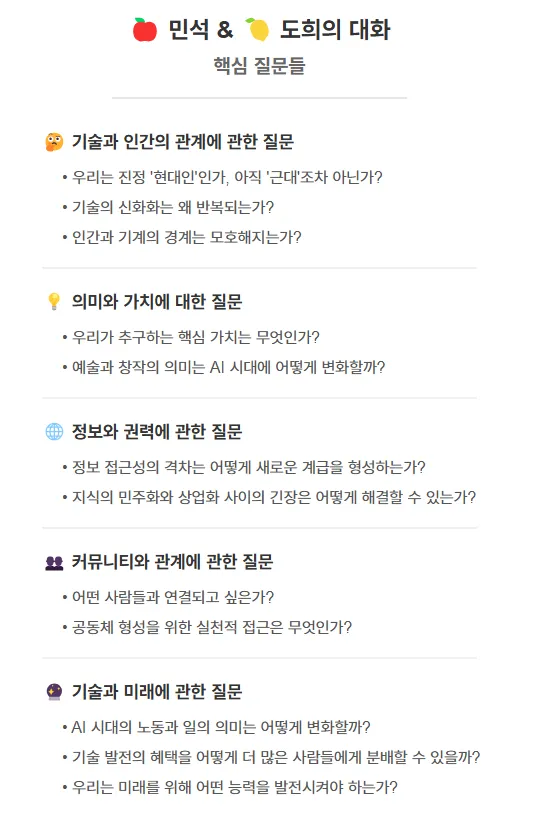
🤔 Questions on the Relationship Between Technology and Humans
"Are we truly 'modern humans,' or are we not even 'modern' yet?"
- Background: The difference between modern/postmodern thought and the modern mindset initiated by Descartes' proposition "I think, therefore I am"
- Concerns:
- 🍎"Modernity, meaning the transition from the medieval era to the modern era in philosophy, had its most significant philosophical point in Descartes…"
- 🍏 "Modernity began with the idea that people exist because they think and think, yet many still don't think that way."
- Discussion:
- Modernity marks the emergence of human subjectivity; the contemporary era centers on humanity.
- 🍎"The modern era is just about humans… In the Middle Ages, God was 100. The modern era saw God become about 40 and humans about 60. The contemporary era is just all about humans."
- Philosophically speaking: The Middle Ages had a theocentric worldview where absolute truth resided with God. Modernity (Modernism) began with Descartes' Cogito and led to the Enlightenment, bringing forth reason, rationality, and the emergence of humans as subjects. Postmodernism evolved through the deconstruction of absolute truth, pluralism, and a relativistic worldview. Each era overlaps and coexists rather than being completely replaced in a linear fashion.
- Technological Context:
- Do modern people, trapped in smartphone screens, engage in genuine thought?
- 🍎"We're watching lectures that are increasingly mindless and chewed-up. Is this truly how we live up to 'Cogito Ergo Sum (I think, therefore I am)'?"
"Why does the mythologization of technology repeat?"
- Background: Comparing current overconfidence in AI with past mythologization of technology
- Concerns:
- "I believe in AI. I believe in AI." - The phenomenon of AI mythologization
- 🍎"Something that struck me from ⟨Preparing for the Future⟩ was that technology has a longer history than philosophy, yet there was no such thing as a philosophy of technology because it was taken for granted."
- Discussion:
- Mythologizing technology is a recurring pattern across eras
- Roland Barthes' perspective from 'Mythologies': Technology is a naturalized ideology, where historically and socially constructed elements are accepted as 'natural'
- Technology was so taken for granted that efforts to think about it philosophically were lacking - The pitfalls of technological determinism
- Historical Pattern:
- Innovative technologies of each era—printing, electricity, radio, TV, internet—undergo similar mythologization processes
- Initial optimism and utopian visions → Actual application and diffusion → Recognition of side effects and limitations → Critical reflection
- AI mythologization is particularly evident in 'Singularity' or 'Superintelligence' discourses
- Technological mythologizing sometimes contributes to the interests and power consolidation of specific groups (technological elites, corporations)
"Is the boundary between humans and machines becoming blurred?"
- Background: Transhumanism and modern human-machine relations
- Concerns:
- 🍋"Humans are becoming mechanized, and machines are becoming humanized, you see."
- 🍋"Everything about how individuals handle tasks is happening in multiples. Like how CPUs and GPUs emerge simultaneously in parallel."
- Discussion:
- The phenomenon of human thought patterns mechanically transforming
- 🍋"In transhumanism, yeah, that was really interesting. The concept is that humans mimic machines, and machines strive to become human…"
- Artistic Exploration:
- Contemporary art explores transhumanism and posthuman discourse in diverse ways
- Stelarc's performance: "The Body is Obsolete" – experiments extending the body through machinery
- Robot art and AI-generated art: Challenging the exclusive status of human artists and the concept of creativity
- Cyborg Aesthetics: Redefining aesthetic value through fragmentation, hybridity, and imperfection instead of classical beauty and harmony
- Donna Haraway's "Cyborg Manifesto": Presents the political potential of boundary collapse and hybrid identities
- Future Outlook:
- 🍋"Someday, when it suits their purpose, won't they just swap places?.. the fake replacing the real."
- Art's role extends beyond merely depicting such change; it actively experiments and leads
- Post-Digital Art: A movement re-recognizing technology's materiality and limitations while deconstructing the digital-analog dichotomy
💡 Questions of Meaning and Value
"What are the core values we pursue?"
- Context: Collapse of shared societal values and the need to redefine personal values
- Reflections:
- "Believing in what I want to do and gaining value from it is a cool thing"
- "What I value is that I really hate it when people tell me what to do, and I get extremely stressed in environments where my autonomy isn't secured"
- Discussion:
- A value system prioritizing autonomy and freedom
- Balancing material success with intellectual/spiritual fulfillment
- Personal Choice:
- 🍎"I'd rather lie in my Seocheon house than own a 3 billion won apartment in Seoul."
- 🍋"I don't indulge in material luxuries much. I feel intrinsic value is really important… but I do want to indulge in intellectual vanity and intellectual luxury."
"How will the meaning of art and creation change in the AI era?"
- Background: Advancements in AI generation technology and the shifting meaning of human creation
- Concerns:
- 🍋 "I feel the value of art itself will become increasingly important."
- 🍋 "AI now creates videos so well that it's lost meaning, so it's crucial to see where we can draw meaning and value from."
- Discussion:
- Comparing AI-generated "flat" content with human "rough-edged" creations
- Artistic utilization of surplus time created by technological advancement
- Historical Context:
- Early 1950s AI discussions: Began with Alan Turing's question "Can Machines Think?"
- 1956 Dartmouth Conference: Official birth of the term "artificial intelligence"
- Russell and Whitehead's "Principia Mathematica" influenced the formalization of computational thinking
- Early focus was on formal modeling of human thought, while artistic creation was long considered "exclusively human territory"
- Future Direction:
- 🍎"I think it's really important where you place yourself in an environment. That's how you materialize in that direction."
- Art as a uniquely human domain for meaning creation
- 🍋"It's going to be led by incredibly strong individuals again, right?" - The enhanced role of the individual artist in the technological environment
- The growing importance of "meaning" and "message" in the age of image overload
🌐 Questions about Information and Power
"How does the gap in information accessibility form a new class?"
- Background: Information accessibility and power relations in the digital age
- Concerns:
- 🍋"In modern society, I think information is power. But I believe access to information is heavily concentrated among specific classes."
- 🍎"So, to access quality information or such things, you first need to be proficient in English."
- Theoretical Context:
- Bourdieu's concept of 'cultural capital': Information and knowledge function as a new form of capital
- Foucault's 'knowledge/power' theory: The production and circulation of knowledge constitute power relations
- Evolution of the digital divide: From the initial 'access gap' to 'usage gap' and 'participation gap'
- Manuel Castells' 'Network Society' theory: Power imbalance between the center and periphery of information flows
- Historical Context:
- Evolution of information power: Religious institutions (Medieval) → Nation-states (Modern) → Media corporations (Contemporary) → Platform/AI corporations (Present)
- Books and Printing: The 15th-century Gutenberg Revolution partially dismantled knowledge monopolies but created new forms of information stratification
- 20th-century Mass Media: Strict separation between information producers and consumers
- Early Internet (1990s): Optimism about information democratization
- Web 2.0 and Social Media: Expansion of participation and production, alongside the emergence of new forms of information monopolization
- Rise of algorithmic power since the 2010s: Opacity in information filtering and recommendations
- Discussion:
- Qualitative differences between primary sources (official documents, papers) and secondary processed knowledge
- 🍋"We need education that gets to the core of things, but that's being kept under wraps, you know?"
- 🍋"I look at official documents first. But people buy lectures on YouTube or…"
- 🍎"Everyone just regurgitates what someone else spit out."
"How can we resolve the tension between the democratization and commercialization of knowledge?"
- Background: Conflict between knowledge sharing and pursuing commercial profit
- Concerns:
- 🍋"I believe truly valuable knowledge is shared by people. For free."
- Discussion:
- Critical perspectives on paid lectures and the commodification of knowledge
- Distinguishing genuine knowledge sharing from commercial knowledge sales
- Personal Experience:
- 🍎 "I also wrote articles on Publy, and a few did well, so I made some money. The reason I took them down was because the kind of knowledge sharing I aspire to is saying 'This is how I did it,' hoping people will take it, absorb it, apply it, and use it as their own…" -🍎 "But people just copied it exactly. They took the template and replicated it identically. That felt utterly meaningless."
- Alternative Approaches:
- Value-Based Pricing: A differential cost model based on the value created
- Community-Based Knowledge Sharing: Building a sustainable knowledge ecosystem where contributors and users operate under clear rules
- 🍋"I also got quite a few lecture offers recently, but I really don't have much money. But the reason I ended up turning them down? It all felt meaningless. It was just teaching people who weren't really engaged."
👥 Questions About Community and Relationships
"What kind of people do you want to connect with?"
- Context: Building meaningful relationships in a fragmented society
- Concerns:
- 🍋"First, when I think about what I'm gaining from the people I'm meeting…"
- 🍋"I think the loose solidarity with Minseok is good. It feels like there's no burden on each other and no sense of responsibility."
- 🍋"I feel my social connections are very disconnected. It seems like the world is heading toward a phenomenon where communities are gradually collapsing."
- Discussion:
- Connecting with people from diverse backgrounds and expertise
- 🍋"I think connecting with diverse people is really good. So I want to form new possibilities, new markets, new relationships."
- Practical Direction:
- 🍋"I also feel a sense of fulfillment through intellectual exchange like this."
- 🍋🍎 "I think I also want to build my own community for my own sustainability."
"What is a practical approach to forming a community?"
- Background: Future-oriented community building strategies
- Concerns:
- 🍋"I think it's more important for both of us to elevate ourselves. Yeah, I feel that way, and Minseok does too. Then, if we each have a certain share of the pie, we can help each other out, right?"
- Discussion:
- Selective relationship building through strengthening individual expertise and influence
- Community building through social media and content
- Action Plan:
- Exploring possibilities for loose collaboration
- 🍋"So it's about slowly, gradually expanding that pool of people we can trust."
🔮 Questions on Technology and the Future
"How will the meaning of labor and work change in the AI era?"
- Background: Changes in the labor environment due to AI and automation
- Concerns:
- 🍋"What I found interesting recently is that Google keeps offering these job training programs… New job categories will definitely emerge in huge numbers."
- 🍋"If humans no longer have to do a lot of labor, they'll have a lot of free time."
- Discussion:
- Leisure time created by technological advancements like self-driving cars
- 🍎"They said gaming would be the most promising field when self-driving cars advance. Gaming and movies, because people will get bored driving cars themselves."
- Concerns and Outlook:
- Potential widening of the gap due to differences in technology access
- 🍎"Some groups will fill this overwhelming surplus of time with art, games, and movies, but what about the groups that can't keep up? How will they live?"
"How can we distribute the benefits of technological progress to more people?"
- Background: The social impact of technology and benefit distribution
- Concerns:
- 🍎"It's already polarized, and this world isn't some normal distribution anymore… People here are seeing this graph shift more and more like this."
- 🍎"How should we proceed amidst this deepening polarization?"
- Discussion:
- Collaboration between technology experts and social sector experts
- Examples of solving social problems through technology (Dolphin Protection Vision AI)
- Action Plan:
- 🍎"What we do at our company is work on things that help accelerate solving those social problems they're tackling."
- 🍎"I think mutual expertise is incredibly important."
"What Capabilities Should We Develop for the Future?"
- Background: Personal competency development in a rapidly changing technological society
- Concerns:
- 🍎"I ultimately believe this is necessary. It's not about the burden of saying it must become a timeless, enduring statement… but rather that it should become a kind of classic."
- 🍎"Maybe we should try to clarify what our core values and core sentences are, sort of like that."
- Discussion:
- Deepening expertise and developing interaction expertise
- Sharing value by expanding individual influence
- Action Plan:
- 🍋"I think it's more important for both of us to prioritize elevating our own expertise."
- 🍋🍎"Showing it on SNS really seems crucial."