Japan's Multi-Location Living Trend and Case Studies
1. What is multi-base living?
Multi-base living (多拠点生活/多拠点ライフ) refers to living and commuting between two or more bases, such as the metropolitan area and regional cities. In Japan, a common pattern has established itself where people work in the city during the week and spend weekends in nature-rich rural areas.
> "Multi-base living (多拠点生活/多拠点ライフ) refers to living across two bases, such as the metropolitan area and a regional city, while commuting between them. A typical pattern involves working in the city during the week and spending weekends in nature-rich rural areas."
Why Multi-Base Living is Gaining Attention
Multi-base living is gaining attention for the following reasons:
- People tired of city life desire to live in nature-rich areas
- The spread of remote work allows people to work without living in cities
- An aging population increases the number of seniors wanting rural living
Additionally, the development of transportation and logistics networks has been a key factor:
> "Recent multi-habitation represents an evolution and advancement of these existing behavioral patterns. Behind this lies the development of transportation networks. Airplanes, Shinkansen bullet trains, and highways now form a nationwide grid. Even most rural areas across Japan can be reached within an hour from a highway interchange."
> "This has virtually eliminated the gap in living standards between cities and rural areas. In fact, urban life is now more prone to shortages of goods."
2. Advantages and Disadvantages of Multi-Base Living
Advantages:
- Ability to enjoy the benefits of both urban and rural areas
- Experience the convenience of work, culture, and education in cities, while enjoying nature and leisurely time in rural areas
- Reduces risk through a dispersed lifestyle that avoids concentrating everything in one place
> "So people who thought 'let's just take the good parts' started multi-base living. It's not about 'moving' to the countryside, but by establishing dual bases, you can begin a loosely migratory lifestyle. You can incorporate the benefits of rural life into your routine without major changes like switching jobs or relocating the entire family."
Disadvantages:
- Time and cost involved in travel
- Managing two bases can be demanding
3. Japan's Representative Service: ADDress
Services supporting this multi-base lifestyle have emerged in Japan. A prime example is the monthly subscription housing service "ADDress".
> "A residential subscription service starting from 9,800 yen per month > > Born from the desire to 'solve the nationwide vacant house problem while realizing a society where you can live as if traveling,' it addresses Japan's severe vacant house issue by introducing new work styles like remote work and multi-base living, which have recently gained attention."
ADDress Features:
- All-inclusive pricing: "Initial costs and utilities are fully covered. Wi-Fi, furniture, and appliances are also provided."
- Flat rate for any home: "The fee remains the same regardless of which home or room you choose."
- Free companion stays: "Family members or friends of the contract holder can register as companions and stay together."
User Experience:
ADDress user Anju Ishiyama evaluated the service as follows:
> "Life at ADDress is one where you might find yourself meeting fellow members in pajamas, saying 'Nice to meet you.' The relationships formed this way are more equal and comfortable, free from the biases that often start with job titles or positions."
> "ADDress gives the impression of being a place where people moving and living with specific purposes can maintain personal space while loosely interacting."
> "Over the past decade, there's been a movement creating diverse communities connected by 'specific purposes' like work or hobbies. But I don't think there's ever been a 'community about living spaces' like this ADDress experience, where you engage as your natural self without titles."
4. Characteristics and Challenges of Multi-Base Living
Multi-base living enthusiasts contribute significantly to local communities but simultaneously tend to face difficulties in relationships with local residents:
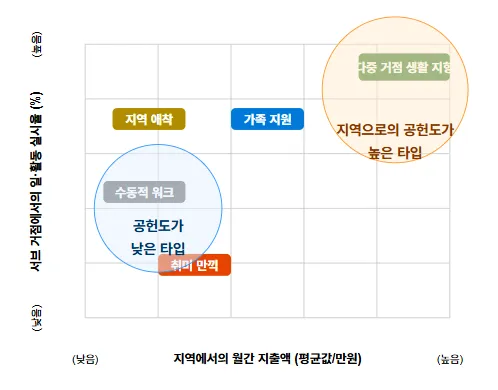
> "Multi-base lifestyle practitioners stand out for both 'labor contribution' and 'consumption,' placing them in the [upper-right quadrant] with high regional contribution."
> "Multi-base lifestyle practitioners felt high hurdles in building trust relationships with local residents (Condition ③). However, their sense of contribution to the region is higher than other types, and they also tend to form connections with the region through side jobs, etc., so Conditions ① and ② are considered partially fulfilled."
Temperature Difference with Local Residents:
> "We often hear that human relationships in local areas involve strong bonds and close psychological proximity… It seems that residents living in rural areas have this consciousness of 'deep and close connection with others' ingrained in them."
> "It was confirmed that for multi-base lifestyle practitioners, the 'number of friends/acquaintances they occasionally contact' and the 'number of people they know by face who exchange simple greetings' tend to increase subjective happiness… This suggests that multi-base lifestyle practitioners desire 'loose connections' where they meet occasionally to talk."
5. Future Outlook
Multi-base living is projected to continue expanding in Japan:
> "Therefore, it seems likely that multi-base living will accelerate its spread going forward."
Furthermore, a "distributed" lifestyle may become the new standard, replacing the traditional "accumulative" lifestyle:
> "In an era where anything could happen—never-ending wars, natural disasters, infectious diseases—even accumulating feels meaningless at times. In such a world, I believe 'distributing rather than accumulating,' 'having multiple options,' leads to peace of mind and richness. Couldn't having multiple small options simultaneously—by decentralizing homes, work styles, and communities—become the new standard for happiness?"
6. Starting a Multi-Base Lifestyle
Advice for those wanting to start a multi-base lifestyle:
> "First, I think it's good to try changing where you spend your time. For example, just go to the seaside on weekends and stay there, even if it's in a hotel. Solo car camping could also be good. Anyway, even if it's just a little at a time, go to places you've wanted to visit and imagine, 'What if I lived here?' Then, you'll gradually understand more concretely what's lacking here and what services would be nice to have. By doing that, start by changing just one day of your daily life. That alone will change the world you see."
[Reference Articles]
- New Rural Return Trend… Japan's Focus on Multi-Base Living
- More People Embracing "Multi-Base Living"
- Being Your Unadorned Self. Comfortable Connections Rooted in Daily Life. [Member Interview] Ms. Anju Ishiyama
- Supporting "Multi-Base Living," Not Just "Relocation." What Towns Introducing Multi-Base Host Regions Across the Nation Are Like
- Challenges Facing "Multi-Location Lifestyle Seekers" with High Regional Contribution ~ Why Do They Feel "Happiness" Yet Also "Unhappiness"?~