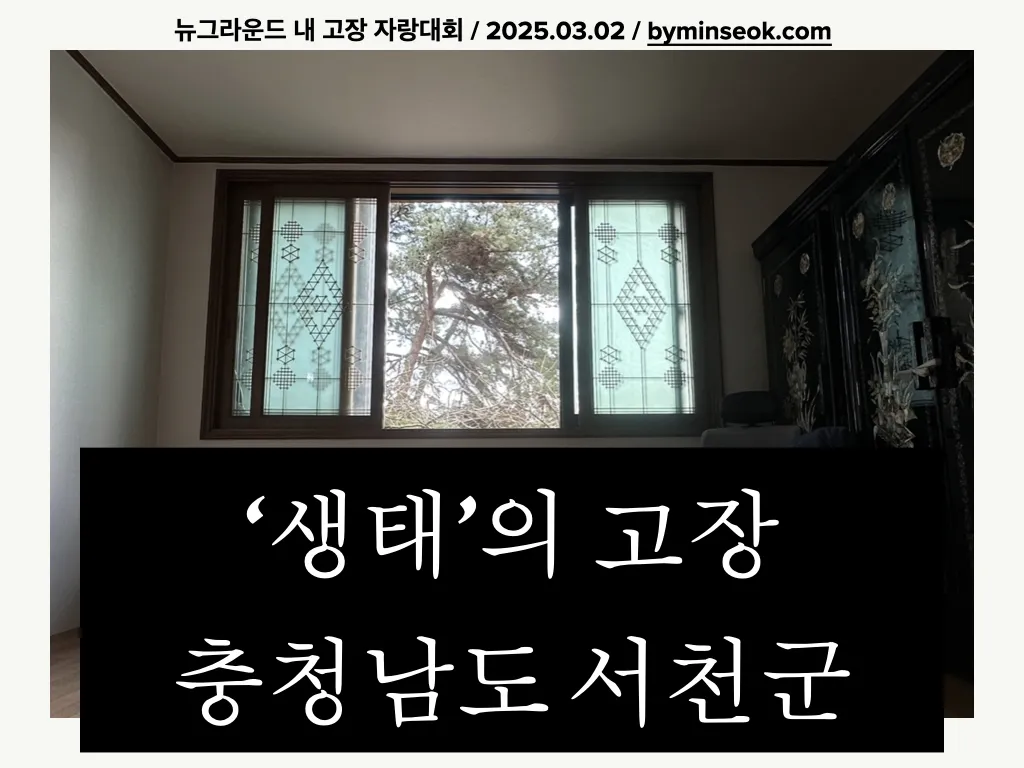
Hometown Pride. Seocheon-gun, the Town of Ecology
Prepared for the presentation titled 'Seocheon County, Chungcheongnam-do: Land of Ecology' for the ⟨My Hometown Pride Contest⟩ held at New Ground
About ten years ago, we promoted the term 'Amenity Seocheon,' but it's not used much these days. Frankly, isn't =='Land of Ecology'== a more accurate description of Seocheon than the ambiguous English word 'amenity'? When I looked up the difference between 'environment' and 'ecology,' Google explained it like this:
> 'Environment' and 'ecology' are often used interchangeably, but a significant difference lies in whose perspective they represent. 'Environment' refers to the surroundings of humans, making it a distinctly human-centered term, while 'ecology' refers to the natural ecosystem, encompassing all living things. (Source: JoongAng Daily 'Environment' and 'Ecology': The Difference)
When you see what kind of natural environment surrounds Seocheon, you'll instantly understand how perfectly the word 'ecology'—which signifies the entire natural ecosystem, not just humans—describes Seocheon.
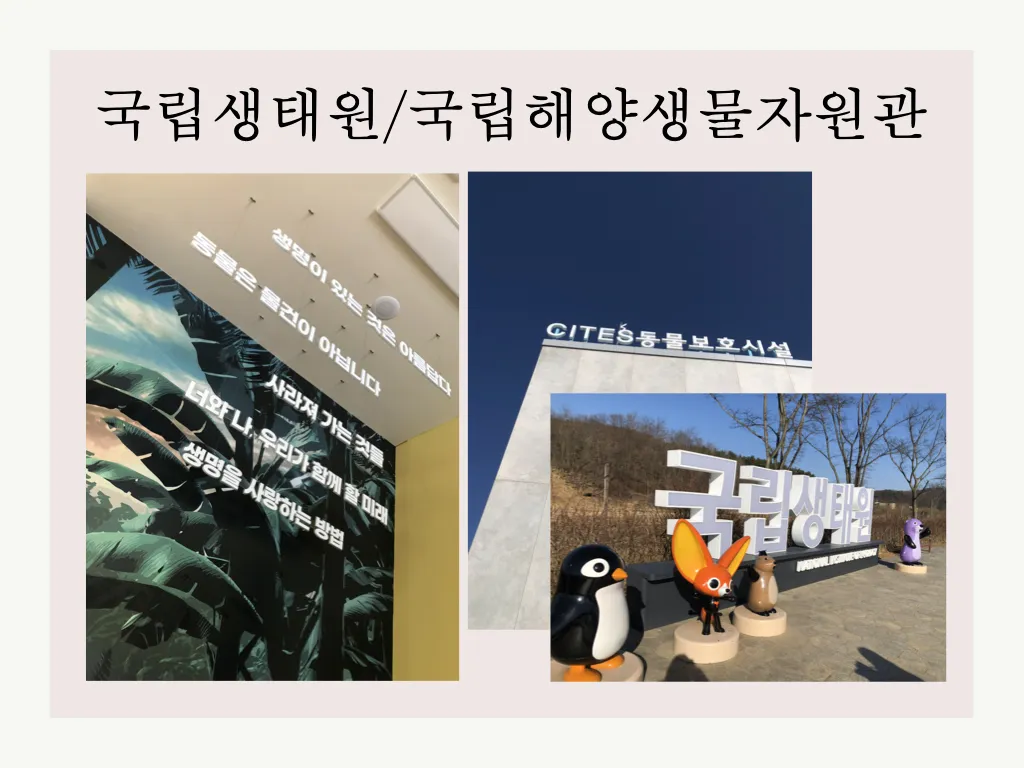
Seocheon has always possessed a rich natural ecosystem, but its significance has deepened further with the recent establishment of the National Ecological Institute (Eco-rium) and the National Marine Biological Resources Institute (Sea-curium). Dr. Choi Jae-cheon, author of ⟨All Living Things Are Beautiful⟩ and an ethologist, also served as the inaugural director of the National Ecological Institute. The institute spans 300,000 pyeong (approx. 990,000 sq m) and is home to diverse plant and animal species. I've only visited once, so I can't go into great detail, but it's a truly wonderful place I highly recommended to my colleagues after my visit.
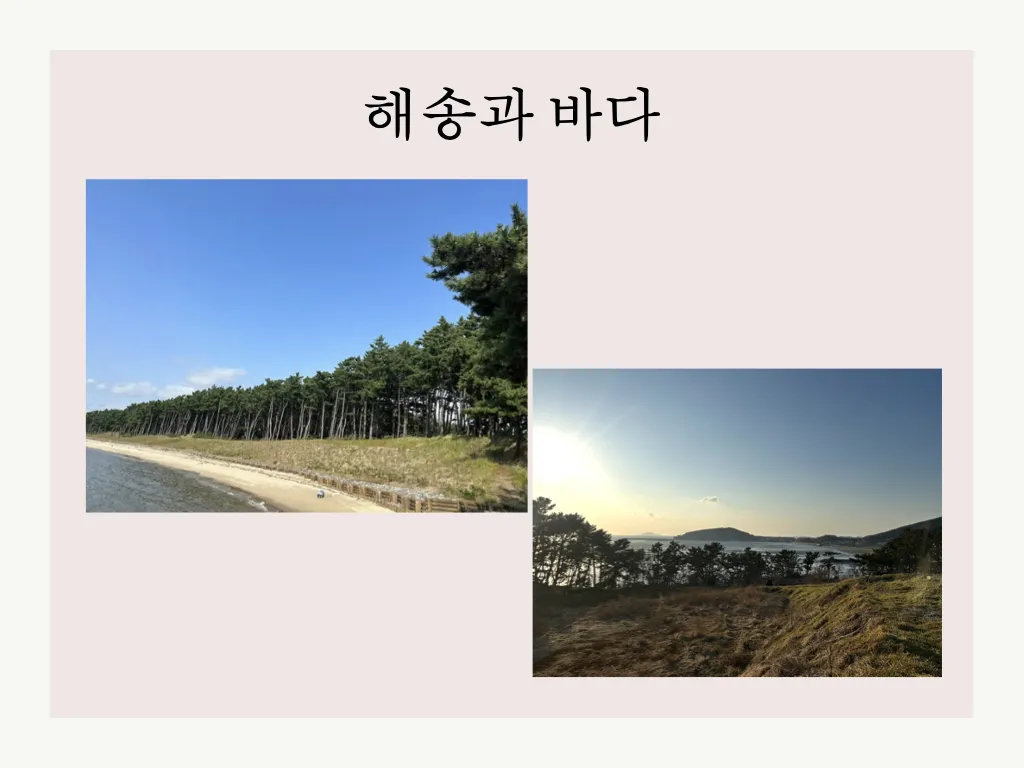
Seocheon is located on the west coast. While the West Sea is often associated with tidal flats with large tidal ranges and murky waters, Seocheon is different. It boasts clear seas with white sandy beaches scattered throughout, and these beaches invariably feature planted pine forests. Jangpo-ri, Dasa-ri, Janghang Songnim Forest Bathing Area… I'm sure there are many more hidden corners of Seocheon where you can enjoy both the pine trees and the sea. For me, the image of Seocheon is precisely this landscape of pine trees and sea. As a child, I loved collecting pinecones, so I'd go to the pine forests by the sea and gather pinecones from the Korean pines. The harmony of the evergreen pine trees and the ever-blue sea—this is the special image Seocheon gives me.
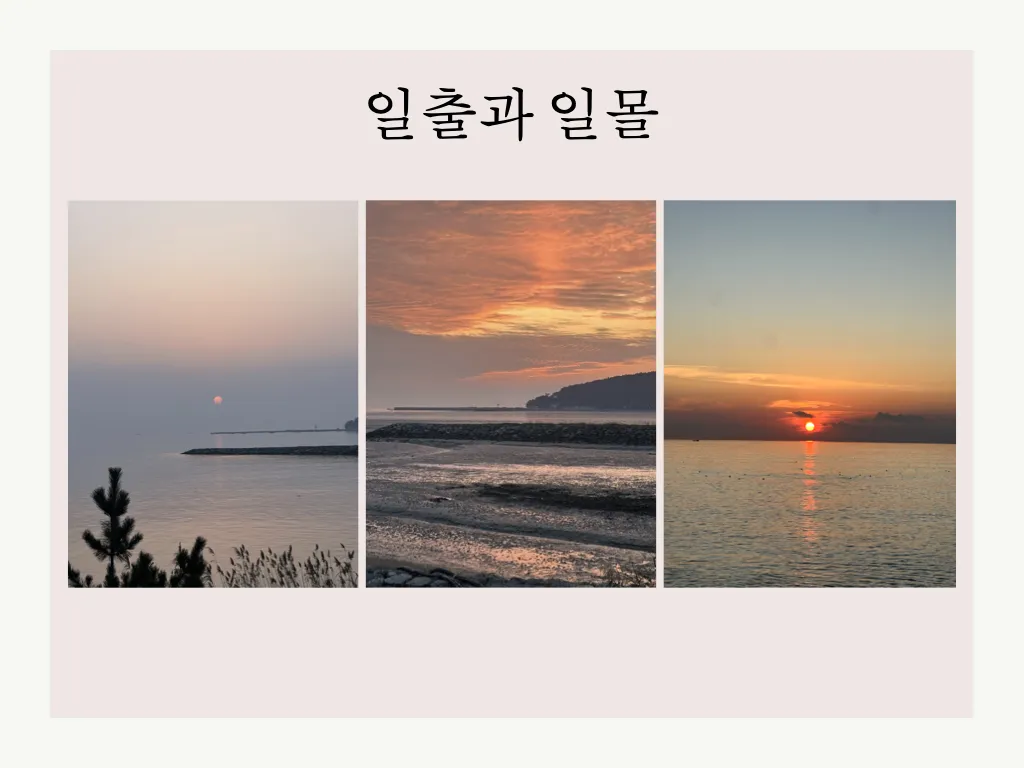
Because it's close to the sea, there are many places where you can see both beautiful sunrises and sunsets. The sunrise I saw last year at Dasari was a magnificent sight, one even my father, a native of Seocheon, said he had never seen before. Occasionally, when the sun sets over the tidal flats, you can witness the marvelous scene of the flats turning pink. The sun's rise and fall feel fresh every day, so Seocheon always offers new experiences. Clouds, temperature, tidal range, wind—all these natural elements combine to create a different scene every moment, making it impossible to ever get bored.
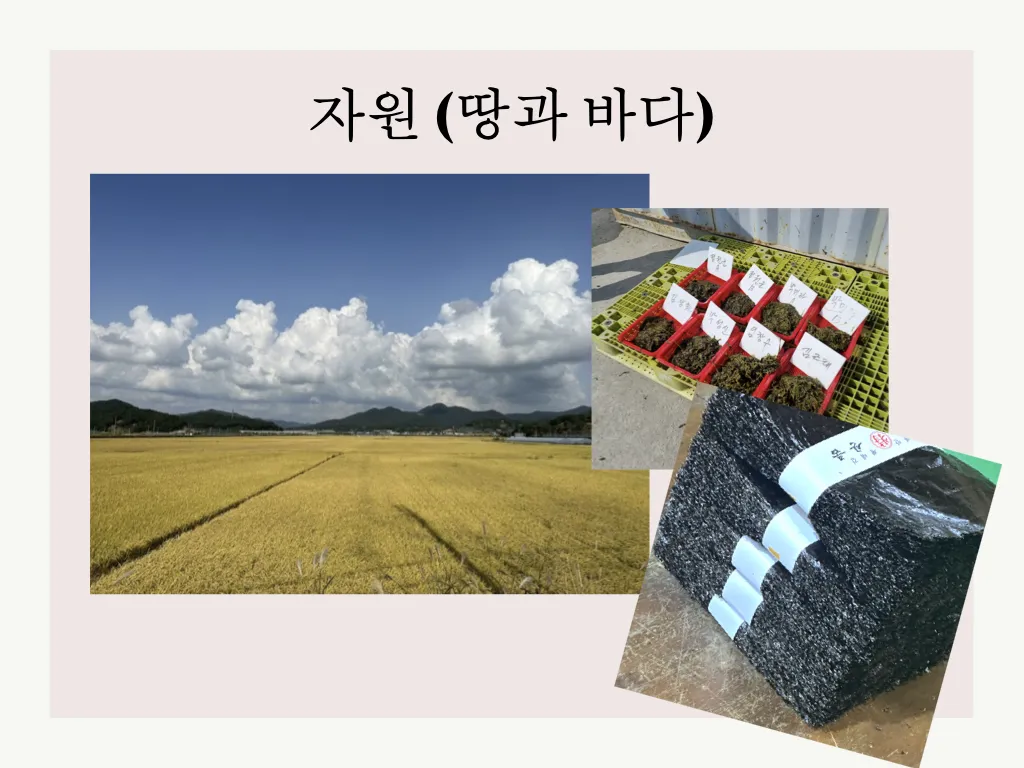
Another pride of Seocheon is its abundant food resources. You can gather fish and tidal flat creatures from the sea, and there are vast plains too. Seocheon rice is said to be especially delicious, perhaps because it grows exposed to the sea breeze. While rice comes from the plains, seaweed comes from the sea. Recently, Seocheon seaweed has gained popularity, with significant exports overseas. During its peak season in winter, I walk to the local seaweed factory to buy it fresh. The aroma of freshly roasted seaweed is incomparably richer than what you find in supermarkets. It can get a bit messy when cooking, but it's worth it for the fresh, delicious seaweed!
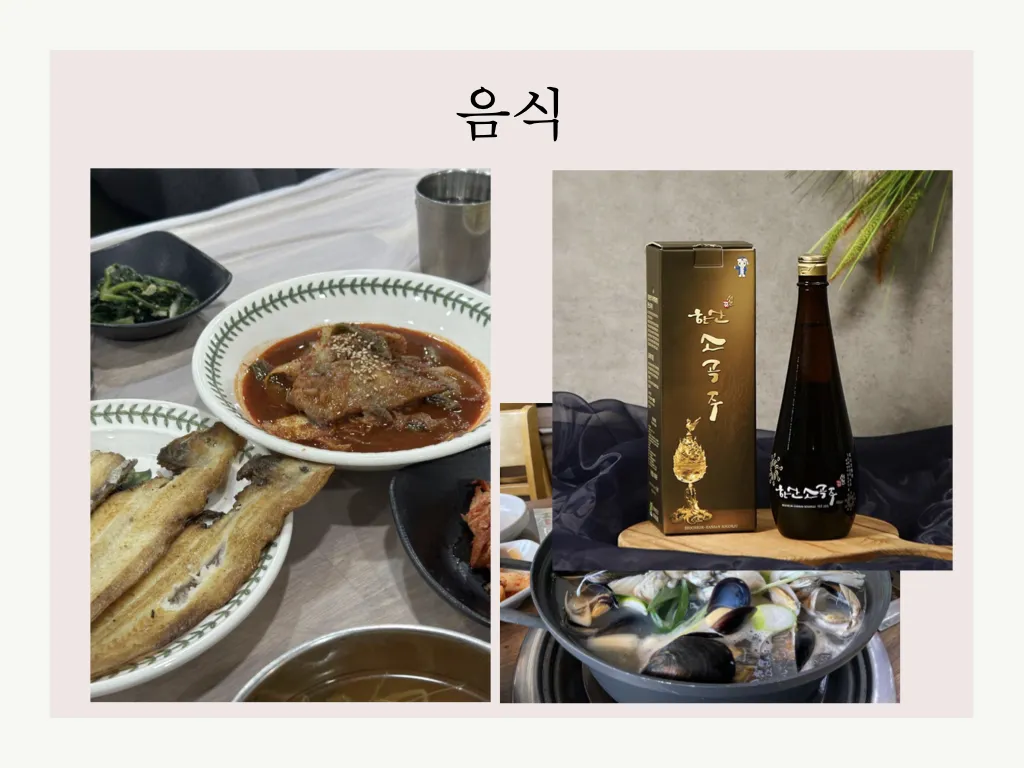
Among Seocheon's foods, my favorites are 'stir-fried or grilled rockfish', 'Hansan Sogokju', and 'seafood knife-cut noodles'. Rockfish is truly delicious whether braised or grilled. Its unique savory flavor and chewy texture make it a must-try dish. Hansan Sogokju is also a proud traditional liquor of Seocheon and truly delicious. You can find seafood knife-cut noodles often near the coast; many places use plenty of fresh shellfish, making the broth refreshingly cool.
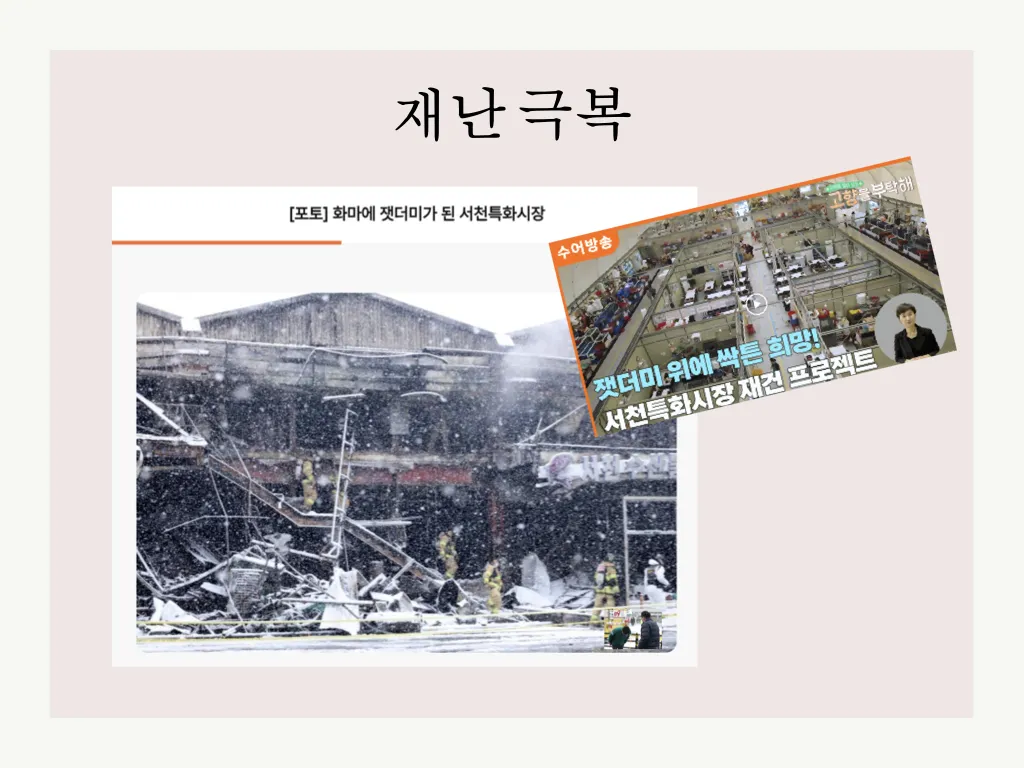
And a few years ago, a major disaster struck Seocheon. A large fire broke out at the Seocheon Specialized Market, which was the largest seafood market in Chungcheongnam-do, resulting in its complete destruction – a truly sad event. I still vividly remember looking at the fire scene on that day when it was snowing heavily. Since then, a temporary market has been set up nearby, and funds are being raised for reconstruction. I also contributed a small part to rebuilding the Seocheon Specialized Market through the Hometown Love Donation system. It was a major disaster, but the fact that many people are working together to overcome it seems to be another source of strength Seocheon offers.
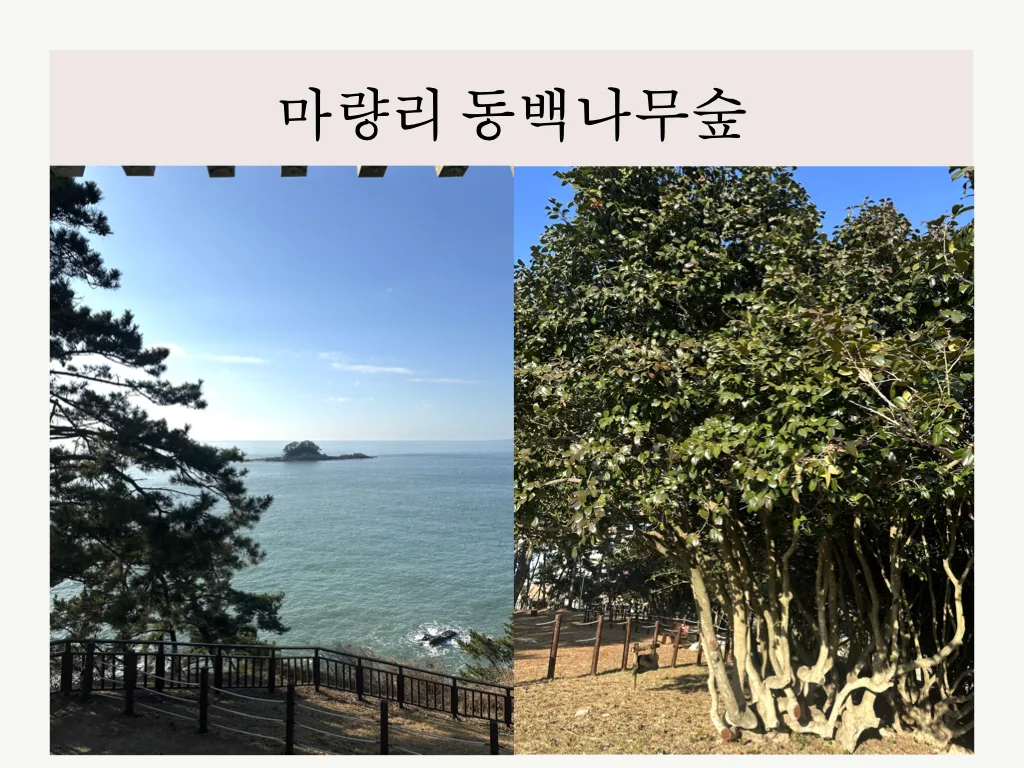
Finally, one of my favorite places in Seocheon is the camellia forest in Maryang-ri. It's home to over 80 camellia trees, some over 500 years old, and it's designated as a Natural Monument. The camellia blossoms here begin to bud in late winter and bloom bright red and vibrant until late spring the following year. Camellias have the characteristic of falling whole, not wilting first. Since they bloom a bit later than those in Jeju Island or the South Sea, you can find fun phrases like 'It's okay to be a little late' scattered around.
What I especially love about this place is the view unfolding beyond the sea when you climb the hill through the camellia forest. Truly, the scenery blending with the pine trees is a wonderful spot whose true charm you can only experience by climbing up yourself. Above all, camellia trees keep their leaves green even in winter, offering the advantage of seeing a green hill year-round. Even in seasons when the camellia flowers aren't blooming.
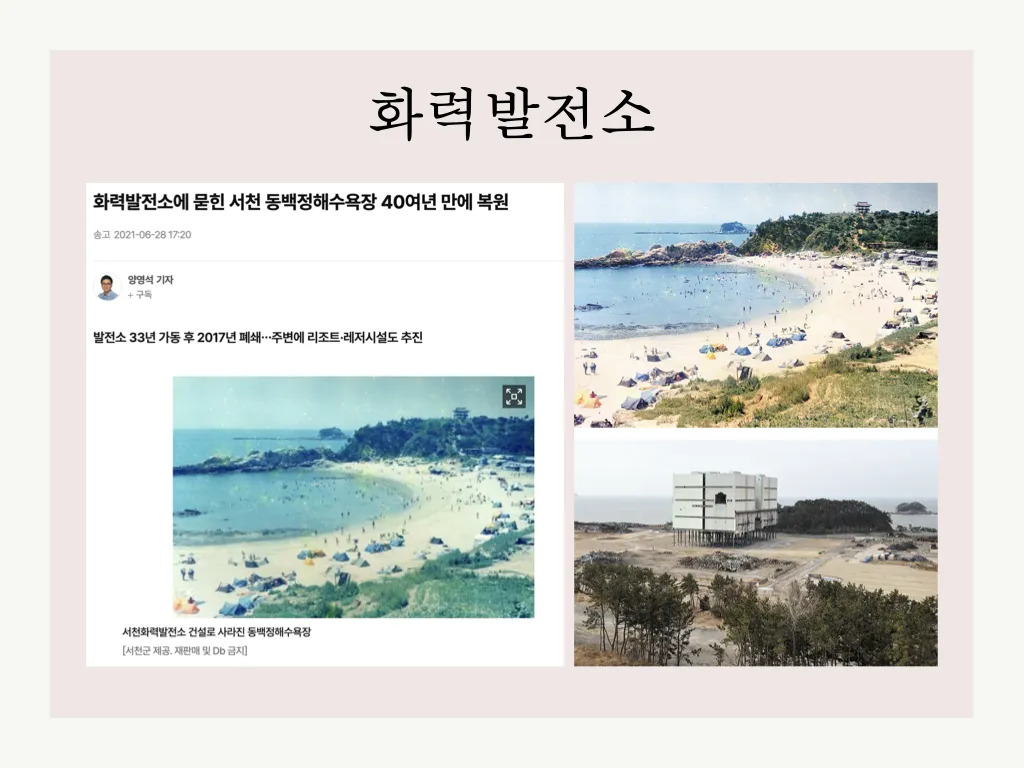
There's another story here: Dad says that when he was young, there was a wide white sand beach near the camellia forest. But when the Seocheon Thermal Power Plant was built there, the beach disappeared. The plant operated for 33 years before shutting down in 2017. Then, construction began on a new thermal power plant nearby, which was recently completed. Now, there's a movement to demolish the old, decommissioned power plant and restore the white sand beach. Currently, it's on hold due to disagreements over the demolition method, but I'm certain that if the beach is ever restored, the already beautiful camellia forest will be set within an even more stunning landscape.
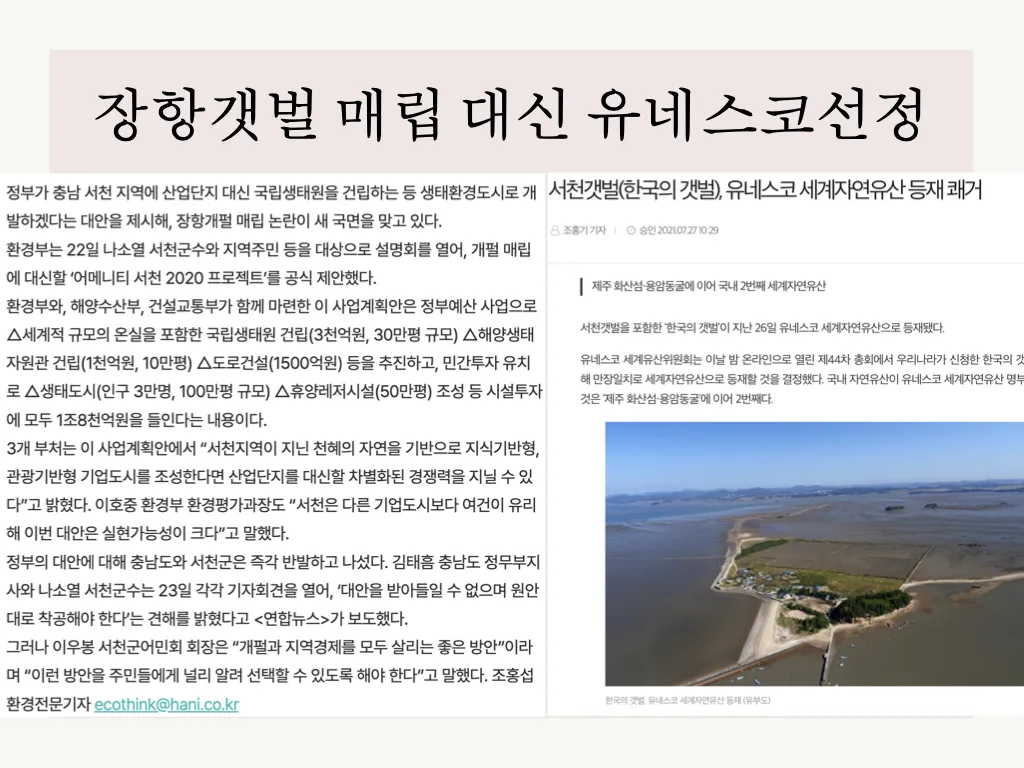
Another source of pride for Seocheon is that Korea's tidal flats, including the Seocheon Tidal Flat, were designated a UNESCO World Natural and Cultural Heritage site. This is linked to a significant turning point in 2007: the 'Amenity Seocheon 2020 Project'. At that time, the Ministry of Environment, the Ministry of Construction and Transportation, and the Ministry of Oceans and Fisheries jointly decided to build an ==ecological environmental city== spanning 2.4 million pyeong instead of reclaiming the Janghang tidal flats. For 18 years, there was conflict between the local government and environmental groups over 'reclamation' versus 'conservation,' but ultimately, the value of environmental preservation was chosen.
Through this project, plans were established to create the National Ecological Center and the Marine Ecological Resources Center, laying the foundation for Seocheon's current identity as an 'ecological hub'. Initially, the local government strongly opposed it, but with the support and persistent efforts of environmental groups, a sustainable development model was ultimately established. As a result, the Seocheon tidal flats became a globally recognized heritage site.
I believe this became the cornerstone for achieving both environmental conservation and regional development. What if the reclamation project to fill in the tidal flats had been implemented back in 2007? How would Seocheon County have changed? Of course, my dad sometimes regrets that not building an industrial complex in Janghang back then meant Seocheon couldn't develop further. But I see it differently. Was turning this place, cradled by such a rich natural ecosystem, into a city packed with factories truly the only path for regional development?
Though the population has dwindled from 150,000 over 40 years ago to under 50,000 in 2025, perhaps for an ecological haven, fewer people might actually be a good thing. Of course, this is probably a perspective only possible because I don't live here permanently.
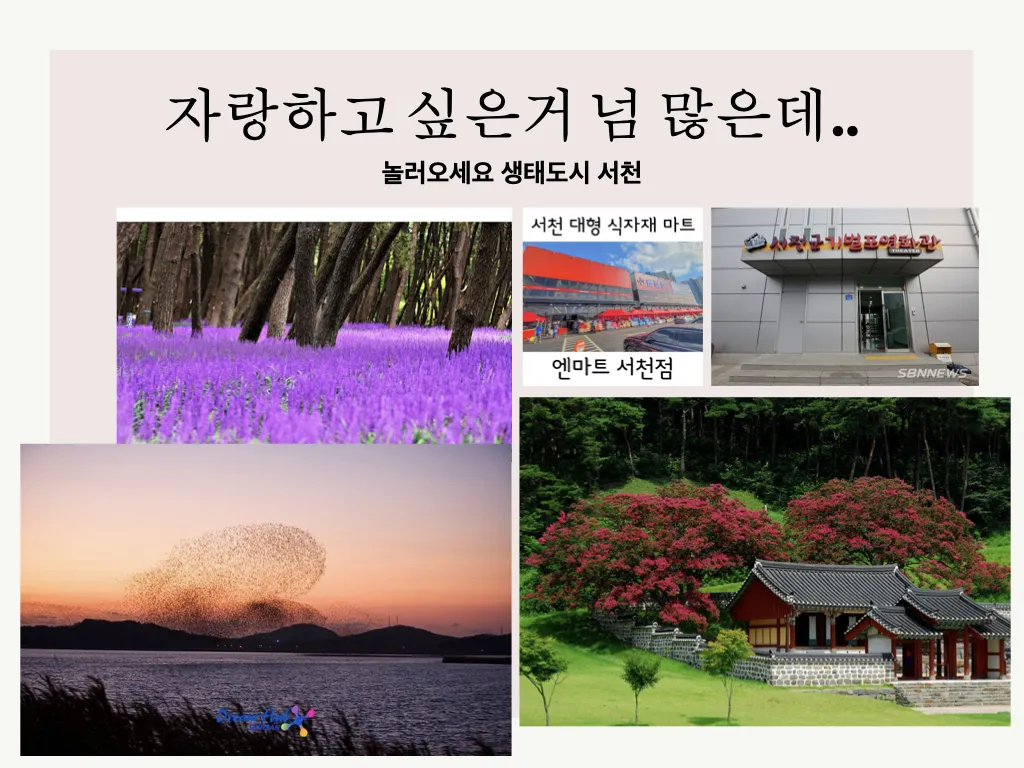
Beyond this, the Solomon's seal blooming in summer at Janghang Forest Recreation Area is truly beautiful, and Gibulpo Movie Theater, Seocheon County's small cinema, has a special charm. I even watched the National Changgeuk Company's video production of the changgeuk ⟨Tree, Fish, Moon⟩ here. The Geumgang River Estuary is a famous migratory bird sanctuary visited by countless birds. My house is about 30 minutes from the Geumgang River Estuary Barrage, but in winter, I can see flocks of migratory birds passing overhead and hear their calls right from home. I haven't visited yet, but Munheon Seowon is also known as a tourist attraction, and the recently opened 24-hour grocery store, Enmart, is a convenient facility. Living in nature while having easy access to a supermarket! It's only a 10-minute drive from my house.
After bragging about Seocheon like this, I really hope more people visit. As a resident of Seocheon, I want to connect with this place more often too. The term "resident population" refers to people who, even if they aren't registered as residents in a specific area, stay there for a certain period for commuting, schooling, tourism, business, shopping, etc., thereby influencing the local economy and culture. Unlike the registered population, it's also an important indicator showing a region's actual vitality and economic potential.
Looking back, I realize my love for Seocheon isn't just because it's my dad's hometown or where my grandfather's house is. The blue sea and pine trees, the beauty of nature changing through the seasons, the leisure and peace you can't feel in the city, and the story of a region that has developed while protecting its environment throughout its long history—that's what keeps drawing me back here.
Seocheon isn't just a tourist destination; it's a special place demonstrating how humans can harmoniously coexist with a vast natural ecosystem. I hope Seocheon's charm becomes known to more people, allowing its value as a place of ecological significance to shine even brighter. That won't just be through 'tourism' alone. It could involve supporting ways to increase the resident population, spreading Seocheon's story further, or connecting it with other places in Korea where natural ecosystems are preserved.
Whatever it becomes, I find myself wanting to contribute to making and keeping present-day Seocheon look even more wonderful. Above all, there's a comfort felt when simply placed within this vast natural ecosystem. I hope more people can experience this comfort.