Jenny Odell - How to Do Nothing
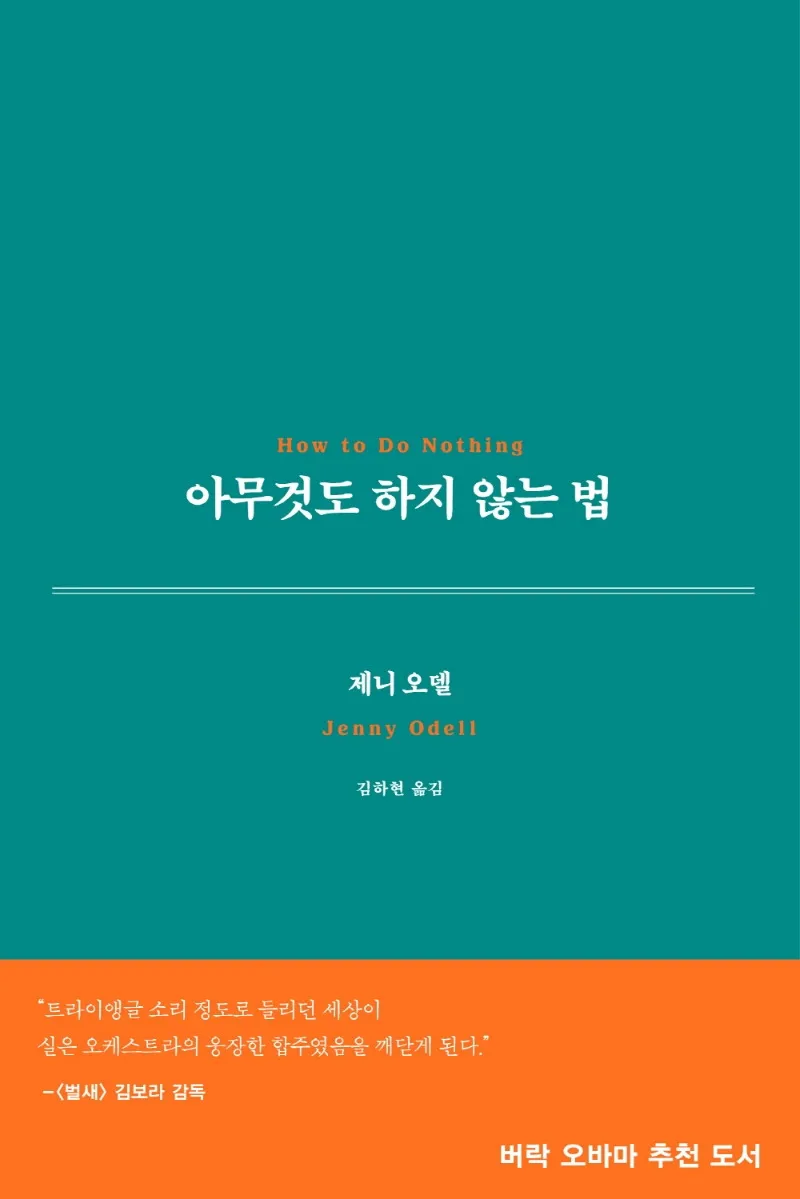
- How I learned about it: I first heard about it around June on a podcast, and seeing the blurb by director Kim Bo-ra on the dust jacket made me even more curious about the book.
- How I got it: Borrowed it from the company library.
- Reading period: August 12, 2022 ~ September 4, 2022
A life embracing ambiguity and room for contradiction
While it often reminded me of Olga Mecking's ⟨The Practice of Turning Off Your Mind⟩, which I enjoyed reading years ago, ⟨The Art of Doing Nothing⟩ isn't a book about boosting productivity. It's closer to a work of political philosophy. The author, who lives in the Bay Area where many tech companies are based, says this in the preface: "Living between a highly developed corporate culture and vast mountain ranges, I cannot help but ask: What meaning is there in building a digital world when the real world is crumbling before our eyes? (p. 22)" In this age of the attention economy, where every effort is made to draw and retain people's attention, the moment this book speaks of the subjectivity and agency of attention, I couldn't help but be captivated.
Deborah Vebriga, who wrote a paper on the attention economy and Persuasive Design, argues that in a digital world constantly striving to capture users' attention, humans are bound to lose. She states, "The outcome is unchangeable; all we can do is adjust the direction of persuasion" (p. 201). Since fragile human agency alone cannot overcome cleverly designed digital spaces, appealing to the ethical aspects of those designing these spaces is a more valid approach. But here, the author strikes back: "I cannot accept the idea that I have already lost the war over attention. I am an agent with agency, and I want to hold the reins of my attention, rather than simply redirecting it in ways deemed better for me."(p. 201) There is a famous saying by a Google designer: "If you aren't paying for the product, you are the product." In the digital world, every user's attention and choice is converted into 'events' or 'actions,' becoming a tradable currency and a basis for persuasion for those designing products. To prevent my attention from being easily reduced to a single event for user group A, "a deeper, more solid, and subtler form of attention" (p. 202) is required.
The author's emphasis on this deep, solid attention stems not merely from a desire to "not let the tech giants take the lead." The author emphatically states, "This book is for artists and writers, but also for everyone who sees life as more than a mere tool—in other words, as something that cannot be optimized" (p. 18). It is a heartfelt plea that the world each of us inhabits does not become "a situation similar to the new weekly recommendations playlist on my Spotify account" (p. 231). If I don't place myself in time and space where new change can occur, my world spins relentlessly according to someone else's algorithm. "Information rushes at me in no particular order, videos autoplay, headlines try to grab my attention. And what is actually being explored behind the screen is me" (p. 287).
Our problem of easily getting lost in the attention economy doesn't vanish by deleting Instagram or Twitter and quitting our accounts. In a world where excessive stimulation has become reality, we need the courage to transform FOMO (the fear of missing out) into NOSMO (the necessity of sometimes missing out). Exercising that courage isn't easy alone. It requires joining hands with the beings around me, placing myself in serendipitous spaces, and stepping away from "producing results the moment I open my eyes in the morning and staying constantly connected" (p. 57). It needn't be grand or noisy. It can start simply by not listening to Spotify's auto-play music on my walk and instead hearing the birds hidden in the trees. After closing the final chapter of this book, I left my AirPods at home and set out for a walk. A different world unfolded compared to when I used to walk with my ears plugged by two tiny bean sprouts. I saw a few leaves hanging from the street trees, tinged yellow and red. I watched a bird, not even a sparrow, making a cute and curious sound. I saw chestnut-like fruits rolling on the ground. Is this a chestnut tree adapted to the city? Wild chestnuts protect their nuts with spines, but in the city, they don't need protection, so did they evolve like this? (When I got home and looked it up, it turned out to be the fruit of a horse chestnut tree.) This experience, pulling my attention out into the world, expanded my world a little more. Listening to birdsong, observing trees and fruits, I returned home to find an hour had swiftly passed. As the author said, I had "escaped the orbit of time spent producing something, allowing a brief moment to unfold infinitely" (p. 73). They say "the longest life is one filled with the most joy where time seems to stand still" (p. 73). The courage to leave my AirPods behind and set out on my walk seemed poised to gift me an even more joyful life, lifting my spirits.
I might not discover something new on my daily walk. That's only natural. Exercising autonomy in my interests means embracing change, ambiguity, and contradiction. The author's insight into the blind spot of personal branding at this point was brilliant. "Friends, family, and acquaintances see a person living and growing through time and space, but the crowd expects only a uniform, unchanging figure, like a brand."(p. 270) Brands are loved precisely because they wield 'internal consistency' and 'timeless steadfastness' as weapons. Yet individuals cannot easily escape change, ambiguity, and contradiction—nor should they need to. Therefore, rather than shouting into the void at a context-deprived crowd, I urge spending more time "speaking to the people we actually want to speak to" (p. 288).
I believe a good book is one that inspires action. ⟨The Art of Doing Nothing⟩ helped me recognize where my attention is directed and the moments when it shifts habitually. It's okay if I can't articulate things clearly. It's okay if things are ambiguous, if there's room for contradiction. If I can fully feel that I am alive and share that with the beings around me, that alone will make it a life filled with the greatest joy. It's a Sunday night where I look forward to the whirlwind of change I'll face moving forward.
P.S. This is a book I wish every product manager grappling with UX in the digital world would read.