Notes Scribbled After Reading 'Aspiring to Leave Seoul'
1. Things That Keep Catching My Eye
I read the hot-off-the-press new release ⟨I'm an Aspiring Seoul-Leaver⟩, out less than a month ago. Since last fall, I've developed an interest in multi-base living, and I've gotten into the habit of seeking out related projects or books whenever I can find them. Once I started looking, I was both relieved and uneasy to discover how many people are already doing or thinking about similar things. The fact that so many people are interested and trying, yet no noticeable change is happening, clearly proves it's not an easy thing.
2. Quality of Life and Living Space
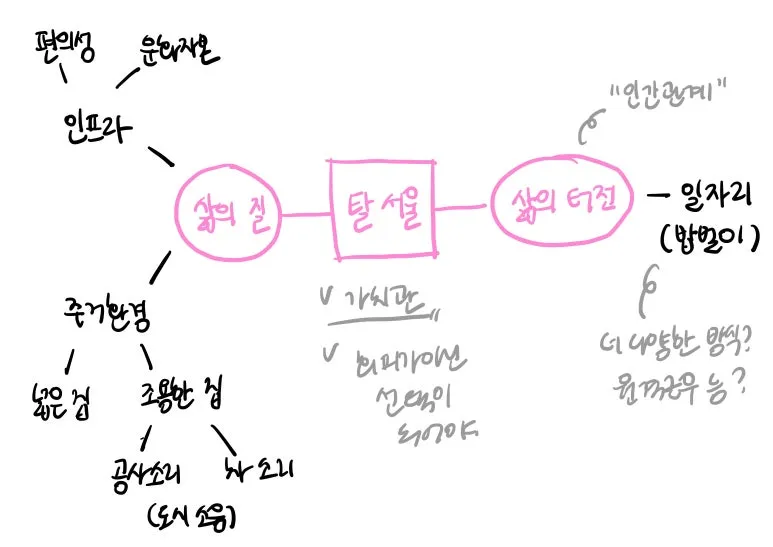
The book approaches the theme of 'leaving Seoul' from two main perspectives: the 'quality of life' aspect and the 'living space' aspect.
-
The 'quality of life' aspect deals with infrastructure and residential environment. Infrastructure is the reason people can't leave Seoul, while residential environment is the reason they want to leave. People feel they cannot leave Seoul because they cannot give up the convenient infrastructure or cultural capital infrastructure unique to Seoul. Conversely, the living environment makes people want to leave Seoul. It's the desire to live in a spacious home, the desire to live in a quiet home free from urban noises like construction or traffic.
-
The 'living foundation' aspect ultimately boils down to jobs. Leaving Seoul without a guaranteed livelihood is only temporary. And this point was also a bit disappointing in the book. While they interviewed various people, the conclusion that 'it's difficult for the average salaried worker' was disappointing. Perhaps because I'm in the IT industry, where remote work or digital nomadism is relatively free, I couldn't fully relate.
> I recalled myself saying I wanted to leave Seoul while looking at Gangwon and Chungcheong provinces, not too far from the metropolitan area. The desperate effort to avoid straying too far from the quality resources and numerous opportunities available in the capital region had somehow taken root within me too. > ⟨I'm an Aspiring Seoul Leaver⟩, p. 145
3. Not 'Leaving Seoul' but 'Expanded Seoul'
The 'leaving Seoul' trend, now frequently covered by media, ultimately represents the choice of people unwilling to sacrifice either quality of life or their life's foundation. More people are moving to Gyeonggi Province—closer to Seoul—because they want better housing than Seoul offers, yet can't give up Seoul's infrastructure, and their life's foundation remains in Seoul.
Can this truly be called leaving Seoul? I began to think the term itself was flawed. Seoul has already expanded its territory beyond Gyeonggi Province. Gyeonggi is not leaving Seoul; it is Expanded-Seoul.
While 'leaving Seoul' as an administrative term may not be incorrect, the sociological meaning of 'leaving Seoul' seems to require redefinition.
4. Dreaming of multi-hub living.
I currently live in Bundang-gu, Seongnam-si, Gyeonggi-do. Three years ago, when I got a job in Pangyo, I simply couldn't endure the hour-and-a-half commute (a low threshold for Seoulites), so I found a place to live just three weeks into the job. Luckily, I lived in a friend's apartment for seven months. After moving out, finding the two-room villa in Bundang-dong where I now live with my sister went smoothly. Then COVID hit. The more time I spent in this house, the more I grew to love this quiet, green neighborhood. Overall, things seemed to work out well.
Then, around the end of last year, I started thinking about multi-location living. Working from home had become prolonged due to COVID, and I grew tired of a job that required sitting in front of a computer all day. Even if I grew and could take on more work here, it seemed the necessity of sitting in front of a computer all day wouldn't change. It was boring.
Words hold immense power. I stumbled upon the term 'multi-base living' and made it my dream. Reading this book only strengthened that resolve. I haven't found the exact 'multi-base living' model I envision yet, but seeing the various attempts around it makes me believe I can discover my own. I think I can do it.
> Changes in work transform homes and lives. It's a chain reaction: 'work → home → life'. The focus is shifting from the traditional 'work-life integration' (proximity) as a measure of success to pursuing happiness through separated work-life living spaces. The recently emerging 'multi-base living' is a prime example. Originating in Japan as a new residential trend, it represents a compromise form of work-life separation. It involves establishing multiple living bases. After the 2011 earthquake disaster, it gained attention as a form of refuge; now, its concepts and forms have diversified and become more specialized. Intertwined with COVID-19 and digitalization, it extends beyond the simple '5-day city, 2-day countryside' model to encompass nomadic lifestyles less constrained by location. In Japan, related books like 'Recommended Multi-Base Living' have become bestsellers. > ⟨Work and Home as Close as Possible? Working Across Multiple Living Bases is the New Residential Trend [Real Estate 360]⟩, Herald Economy
5. What I Don't Want
Without clear personal values, you easily get swept along by life. Especially if you're like me—a people person, impulsive, and prone to falling for things quickly… Of course, unavoidable situations exist, but at least with clear personal values, you can choose rather than avoid.
Before thinking about what I want, I first considered what I don't want.
1) Half-Baked Village Community Projects Having had an experience in my early twenties where the word 'village' made me cringe and shudder with disgust, I now approach the word 'village' with deep suspicion and prejudice. Any place half-heartedly talking about village communities immediately earns my skeptical gaze. I wish a place would come along to shatter my prejudices, but until then, I'll likely keep viewing them through a lens thick with bias.
2) Living in a House Sitting on a Massive Mortgage > "Even without a house, life is hard, but even if you manage to get one, the life of living with a massive mortgage, tightening your belt, and struggling for the rest of your life is unbearable," he said. (⟨Aspiring to Leave Seoul⟩, p.161.)
Buying a home in Seoul or expanded-Seoul is impossible without a loan. Getting the loan itself isn't the problem. In a capitalist society, borrowing is a natural method. Why does everyone keep talking about leverage, leverage? But getting the loan isn't the issue. What I dislike is how your attitude toward life changes after taking one. I don't want to live constantly on edge. I don't want to live perpetually mortgaged. Leverage should be something I pull by my own will, but I don't want to hand over my entire peaceful life to leverage.
6. What I Possess
To live a multi-base lifestyle, you need multiple foundations. Reading books has made me realize more than ever that 'employment' is paramount. Isn't the reason I live in Bundang right now because of my job? That's right.
1) Remote-friendly roles and industries I work in the IT industry, specifically on cloud platform-related tasks, so I believe I could transition to a remote work environment anytime. While I currently have much to learn in various aspects at my present company and have no immediate plans to move to a remote-friendly firm, I believe it could be feasible within the next five years.
2) Existing regional bases My grandmother's house is in Ssangchi-myeon, Sunchang-gun, Jeollabuk-do, my mother's hometown, and my grandfather's house is in Jongcheon-myeon, Seocheon-gun, Chungcheongnam-do, my father's hometown. Both locations are viable candidates to establish as bases.
3) My Own Content Capital and Career Path Beyond my company job, I have my own content capital and the corresponding career path it enables. I can earn about 80% of my monthly living expenses through side income each month. While work is steady now, even if it dries up, I have my own content capital to fall back on, allowing me to pursue anything. Considering that a job is the most crucial element in establishing a life base, I believe the cornerstone for multi-base living lies in effectively distributing energy between 1) and 3) while nurturing them.
4) People and Communities Across Diverse Fields Living a busy life moving around everywhere has led me to know many people. Though Korea is a small world where everyone is connected by one degree of separation, I can meet almost anyone I want to meet. I have connections in diverse regions. I have a guesthouse I frequent and grew close to in Jeju Island, a close friend's home in Hoengseong, Gangwon Province, and Sunhyang's van life in Suncheon, Jeollanam-do! My acquaintances span diverse industries: media, social sector, IT, architecture, film, biotech, and more. I'm also part of many loosely connected communities. For a multi-base lifestyle, staying loosely connected to people is crucial. I don't use Instagram anymore, but when I can connect with people, I should talk more often about what I want to do. Because that's how impossible things become possible.