Kim So-young - The World of Children
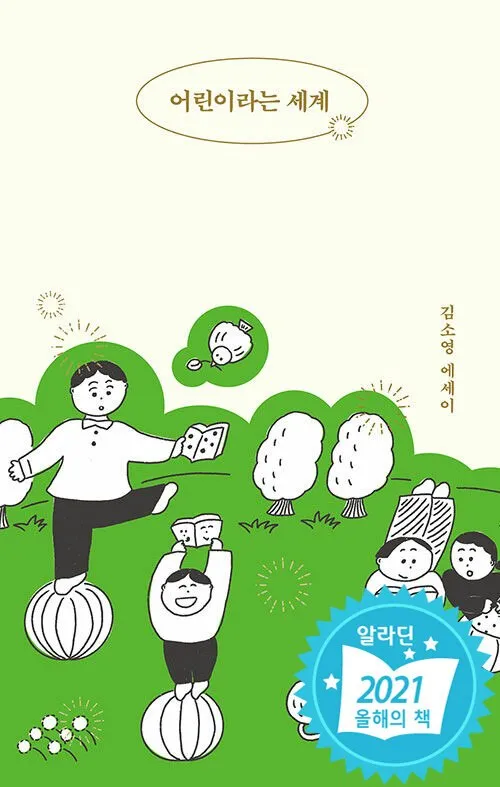
- How I found out about it: I heard so many good things about it from people around me all last year that I got curious.
- How I got it: I went to the Seohyeon branch of Aladin Used Bookstore and bought it in mint condition.
- Reading period: January 9, 2022 ~ January 13, 2022
Because you can't be familiar with everything already
I read the essay ⟨The World of Childhood⟩ by Kim So-young, who runs a children's reading class. My face was filled with smiles, then tears, then laughter, and sometimes I felt embarrassed. I used to think the opposite of a child was an adult, and that children naturally become adults when they grow up. But now, I'm not so sure about that standard. After all, at some point, we label 'a state of being unskilled at something' as childhood. But are children really only in a state of being unskilled? Mobersil knows far more than I do. They know Minecraft and TikTok far better than I do. They simply inhabit realms and worlds I don't know. There are likely many things children understand far more deeply than I do. When I was a child, I played the harmonica well. Every Thursday, I went to the Shinsegae Department Store Cultural Center to learn harmonica. I was also good at inline skating. I'd skate laps around the park in front of my house. I played much more often at friends' houses, at the playground, on the school field. I prayed more earnestly at church. I could even make a large bouquet of roses with origami. There are things I can do now that I became an adult. I can drive a car, I can ride my bike for over two hours, I can fly alone to Jeju Island for a trip. The child I was and the adult I am now are simply capable of different things. What I was good at then, I might not be able to do now, and what I can do now, I couldn't do then. Being unskilled at things I haven't tried yet is only natural. Whatever it is, becoming familiar and mature requires physical time. Time. I fear we might become a society that won't wait for that time. A society that absolutely cannot tolerate anything unskilled or imperfect. A society that won't accept even the slightest mistake or error. And a society that recoils in horror and tears away anything that even slightly damages or tarnishes its own. The gaze that sees such a situation as natural. All of that felt frightening too. I want to live by teaching what is unknown and correcting what is mistaken. I don't want to be someone who puts up barriers to keep others out, scolds them into submission, or publicly shames them by displaying their mistakes. Not just because we were once children, but because we can never be people who are already familiar with everything. We can't always do everything perfectly, as if we've always done it.
Five Sentences
> "So as you grow up, tying your shoelaces will gradually get easier." Hyun-seong replied calmly. "That's true, but I can tie them now. Adults just do it faster; it takes kids longer." I didn't look in the mirror, but my face must have flushed. I can do it now. Hyun-seong clearly said he 'practiced' earlier. Children aren't only capable of doing things later. They can do them now. It just takes time. (p. 18)
> After Jarami left, I saw this passage in the letter: "You have this book, right? But even if they're all the same book, this one has my heart in it." 'This book' holds Jarami's heart. I will read it with my heart too. So even if they look the same, they are all different books. Jarami is absolutely right. (p. 72)
> Children create themselves. And within 'themselves' are not only joyful memories and achievements, but also wounds and scars. Not only strengths, but weaknesses too, belong to the child. Not only the differences from others, but also the similarities, even the exact sameness, are unique to the child. By reframing individuality as 'uniqueness,' I finally realized how many diverse people live in the world. When we say we create a new self every moment as we live, 'diverse' is actually close to 'infinite.' (p. 91)
> "If unification happens, the children of today will be adults by then. What if problems are discovered later? We can't just know the good points, fail to prepare, and then say 'Oh, this isn't right' and pretend it never happened. We'll be the ones who have to solve it then, so why aren't children being asked for their opinions?" (p. 231)