Grow Strong Enough to Break Free
Uncle Ki-ju has always been Uncle Ki-ju. He's Mom's younger brother, doesn't even live nearby, and we only see him during holidays just like other relatives. Maybe it was the title. Uncle Ki-ju always felt like someone not so distant.
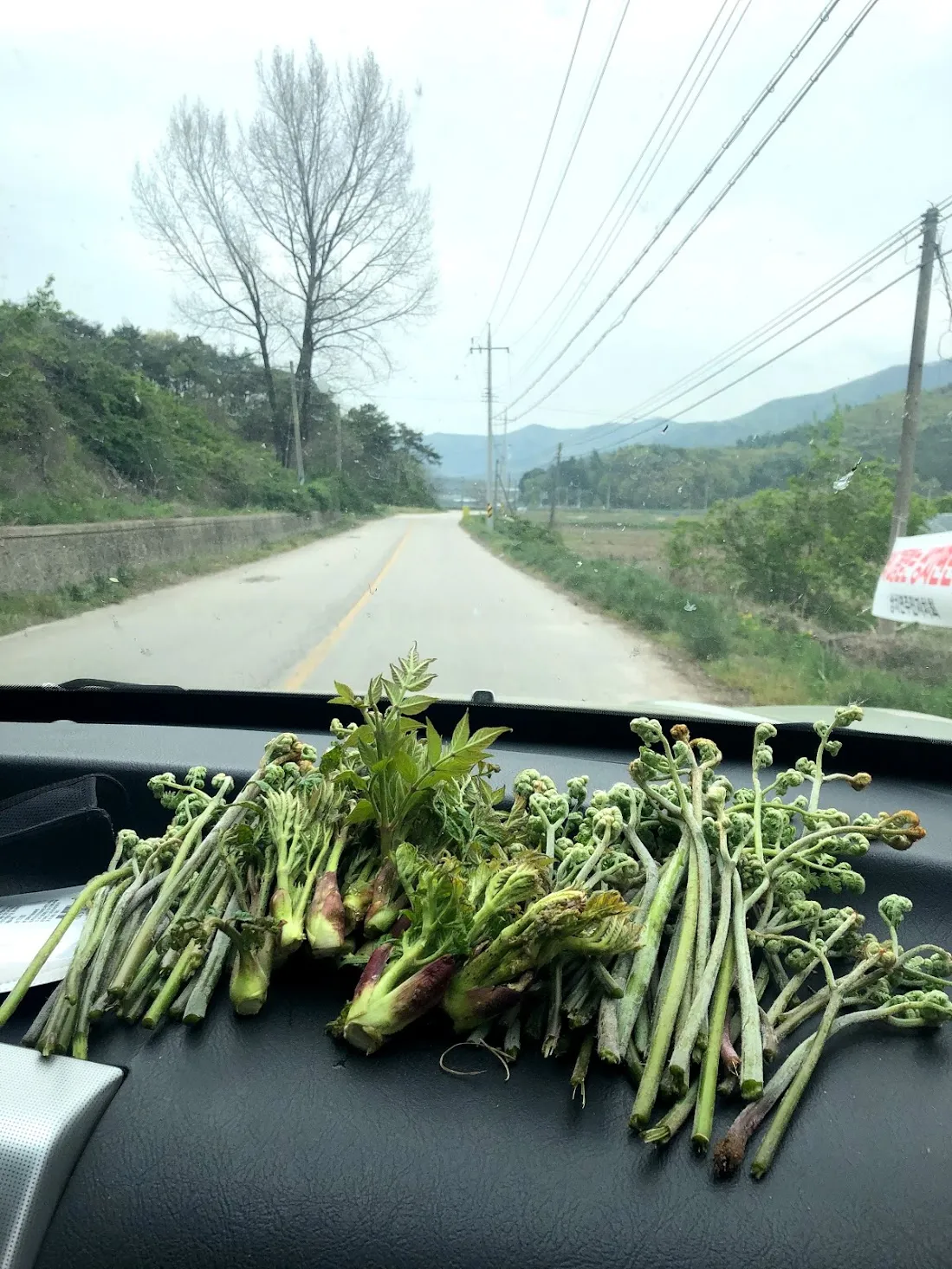 | Wild asparagus and bracken fern picked by my uncle. Last May.
Uncle Ki-joo was a skilled driver, drove aggressively, had a loud voice, and loved popular TV shows. He adored dogs, so on his way back from fetching water, he'd carry a car full of sausages to give to other people's dogs. When he was diagnosed with lung cancer five years ago, he wore the rosary I'd bought for him at St. Paul's Cathedral in London around his neck. He didn't even know rosaries aren't necklaces in Buddhism. He wore it around his big head, saying his niece had bought it for him. We climbed a mountain together, and he picked a huge bunch of wild asparagus for me. He nagged me endlessly, asking who would eat the tiny ferns I picked. Yet he introduced me to his friends as "our pretty nephew." Even though he had so many relatives, no one had ever called me that affectionately before, and it felt wonderful. I rode that not-so-great bike all over Ssangchi Hill, day and night. Maybe it was sheer determination to live longer. Or maybe it was thanks to that. Uncle even got to see his eldest son's wedding. Uncle Giju got angry easily, but he also laughed a lot. He kept making jokes—you never knew if they were serious or not—and made people laugh. I used to say that if I had an ideal type, it would be someone humorous like Uncle Giju. Once, when he saw a cold noodle restaurant sign that read 'Cold Noodles with Meat Served,' he laughed, saying 'Meat Served = Cold Noodles.' After that, whenever I passed a cold noodle place, I'd always check the sign again to see if it said 'Cold Noodles with Meat Served.' I'll probably keep doing that.
The day before Uncle Ki-joo passed away, Mom called saying she felt anxious all day. She booked me an early morning train ticket to go down to the hospice ward in Jeonju the next day. And that was the last time. I never expected it. I knew that day would come someday, but not so suddenly. Even though it's year-end, my heart is still heavy, so I was having lunch with another team colleague I met that morning. I was pouring out my worries about workplace relationships when my sister called. She never calls during lunch, so I felt uneasy. Even while listening to my colleague, my eyes were glued to my phone. As soon as we finished talking, I excused myself and answered. Tears came even at my sister's calm voice. How could this happen just hours after Mom went to Jeonju? I hadn't told Mom to go down knowing this would happen, but my heart ached. Tears fell. When I explained the situation to my colleague, she cried with me. I was grateful.
Thanks to Uncle Ki-joo, I started my year-end vacation a day early. My original plan was to take the vacation straight from the 23rd until the end of the year, but I could use an extra day off to see Uncle off. The three-day funeral process was one of sending Uncle off, and then sending him off again, and then sending him off once more. Throughout it, family members helped each other endure the ordeal. Setting up the funeral altar, receiving guests, accepting floral tributes, placing him in the coffin, and receiving more guests. On the final night of the funeral, Uncle's friends came to drink for him. The next day, Uncle's friends carried the coffin. From the Seoul funeral home to the crematorium in Gongju, and from the crematorium to the burial site. Family and Uncle's friends walked that long road together. Though it was late December, the day wasn't cold at all. We buried Uncle's urn beside Grandfather. The sky was blue, the wind was cool. It felt like May weather, not December. We held the final memorial service for Uncle in a sunny, good spot. There was bracken fern, which Uncle loved. I remembered picking bracken with Uncle on this very mountain, and wiped away tears again. There were so many people. Neighbors, Uncle's friends, family—over thirty people planted grass on the grave site. Both my uncle, wearing his fine shoes, and I, in my white sneakers, stomped the soil hard to help the grass grow well.
> To them, will both families be a source of strength or a shackle? May they gain strength to break free from the shackles. (Park Wan-seo, ⟨A Very Old Joke⟩)
As I stomped the soil, a passage from a book I'd read long ago lingered in my mind. Whether family is a shackle or a source of strength, ultimately they are beings who can be a source of strength. And while growing strong is one's own responsibility, family is also what can provide that much strength. Amidst various emotions, I thought this.
When Uncle Ki-joo passed away, they said a single bee flew into the yard of Grandma's house in Ssangchi, where she lived alone. They said the bee buzzed around the yard once and then flew away. Grandma said, seeing that bee, "Ki-joo has gone." Not long after, a call came for Auntie, and Grandma already knew. While we were tidying Uncle's grave, another bee came. Mom said, "Ki-joo?" Auntie Hyun-mi teased, "Not a butterfly, not a bird—what kind of bee is this? Just like him. Now, brother, you have to become a gentle man." I told my uncle that a bee suited him perfectly. A stinging person, a person who gathers honey through cooperation—it fits him well. I must gain strength too, become strong enough to break free from the shackles. The point of this resolution isn't breaking the shackles, but gaining strength and becoming strong.